Founding fathers of scientific thinking - Thomas Bradwardine
Brief history of atheist thought in Europe, XII century c.e.
HistoricalBrief history of atheist thought in Europe, XII century c.e.
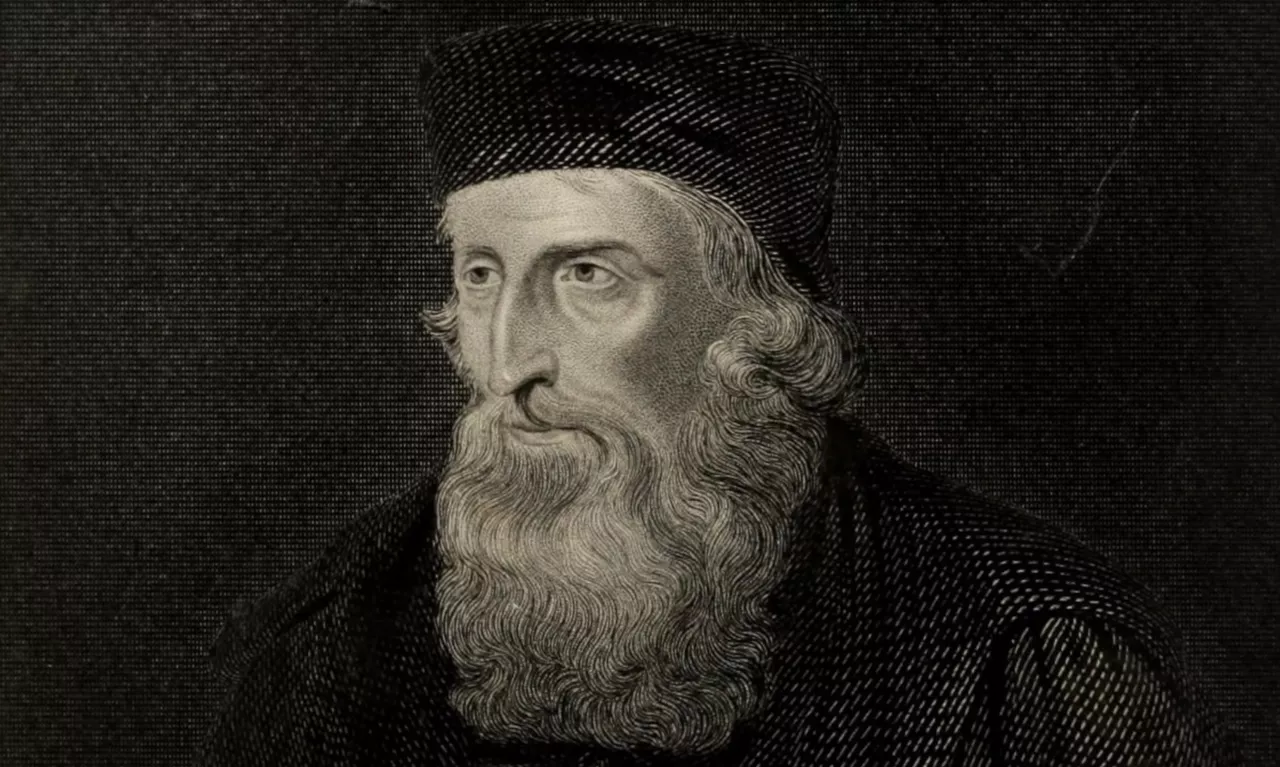
John Wycliffe (John Wyclif) received his education as doctor of divinity in 1372, doubted as a “morning star of the reformation”, had a profound effect on the social aspects of 13th century England and on the power of the Roman Catholic Church. He was influenced by apocalyptic ideas of his time, he challenged the dogma of Eucharist, rejected the ideas of transubstantiation, although without providing alternative explanation. He redefined pre Ockamian ideas of universals and indivisibles.
Wycliffe challenged the authority of the Pope and Catholic Church itself, stating the facts of corruption that, in his opinion, disqualified that institution as a whole to be representative of any divine connection. His main act of defiance - translation of the Latin Bible to English, providing common people with access to “divine wisdom”, free from control of the clergy.
He was condemned as a heretic, however, shielded by protection of the aristocracy was able to avoid punishment, unlike his followers. He produced copious writings in logic, theology, nature and politics.
Wycliffe’s influence was felt during the Reformation and echoes to this day.
During the beginning of the Thirtieth century, central authority of the Pope weakened, corruption and irregularity was common. In England, the Catholic Church was challenged by Edward the III, local clergy accumulated a substantial amount of wealth.
"John Wyclif was born near Richmond (Yorkshire) before 1330 and ordained in 1351. He spent the greater part of his life in the schools at Oxford: he was fellow of Merton in 1356, master of arts at Balliol in 1360, and doctor of divinity in 1372. He definitely left Oxford in 1381 for Lutterworth (Leicestershire), where he died on 31 December, 1384. It was not until 1374 (when he went on a diplomatic mission to Bruges) that Wyclif entered the royal service, but his connection with John of Gaunt, Duke of Lancaster, probably dates back to 1371. His ideas on lordship and church wealth, expressed in De civili dominio (On Civil Dominion), caused his first official condemnation in 1377 by the Pope (Gregory XI), who censured nineteen articles. As has been pointed out (Leff 1967), in 1377–78 Wyclif made a swift progression from unqualified fundamentalism to a heretical view of the Church and its Sacraments. He clearly claimed the supremacy of the king over the priesthood (see for instance his De ecclesia [On the Church], between early 1378 and early 1379), and the simultaneous presence in the Eucharist of the substance of the bread and the body of Christ (De eucharistia [On the Eucharist], and De apostasia [On Apostasy], both ca. 1380). His theses would influence Jan Hus and Jerome of Prague in the 15th century. So long as he limited his attack to abuses and the wealth of the Church, he could rely on the support of a (more or less extended) part of the clergy and aristocracy, but once he dismissed the traditional doctrine of transubstantiation, his (unorthodox) theses could not be defended any more. Thus in 1382 Archbishop Courtenay had twenty-four propositions that were attributed to Wyclif condemned by a council of theologians, and could force Wyclif’s followers at Oxford University to retract their views or flee. The Council of Constance (1414–18) condemned Wyclif’s writings and ordered his books burned and his body removed from consecrated ground. This last order, confirmed by Pope Martin V, was carried out in 1428.
The most complete biographical study of Wyclif is still the monograph of Workman 1926, but the best analysis of his intellectual development and of the philosophical and theological context of his ideas is Robson 1961."
Conti, A., John Wyclif (Article) - The Stanford Encyclopedia of Philosophy (Spring 2017 Edition), Edward N. Zalta (ed.), WEB 2023
Dominicans, as agents of the papacy, were on the mission to convert as much of England as possible, however due to bluntly corrupted practices their actions were not welcomed by the public. Uneasiness grew and controversy had to be addressed. In “Objections to Friars”, 1382 in which Wycliffe accused Franciscans of heresy and self-serving practices that went against the intent and “religion of Christ”. (Deane, 1884). Opposing “begging friers” was dangerous for Wycliffe, the inquisition was still influential and Dominicans had lots of political power. Nevertheless, Wycliffe’s stand resulted in friars pledge to word of Bible that supposed to suction their action, that prompted Wycliffe and others to study that cross-references closer. Thus, bringing to public debate how much The Church has deviated from the teaching of the Bible.
Wycliffe, as his predecessors and contemporaries, struggled to explain absolutes that were derived from Christian doctrines, a priori futile attempt. He created sound logical arguments, however baseless there were, that provided a framework for metal exercises that expand the idea of interconnectedness and logical succession of form, time and place. Unable to place that idea into the natural processes, he circles back to the common crutch of all logicians of the time - the myth of creation.
"The Dominicans first entered England in 1321. They speedily multiplied and spread over the kingdom. Forty-three houses belonging to their order were established, and from their black cloak and hood they became popularly known as the" Black Friars."
The Franciscans by pious frauds endeavoured to monopolise the wealth of the country. "Every year," they said, "St. Francis descends from heaven to purgatory and delivers the souls of all those who were buried in the dress of his order." Numbers assumed his garb in consequence.
These friars used to kidnap children and shut them up in monasteries. Their practices at the universities were so bad that Fitzralph-Chancellor of Oxford in 1333, and Archbishop of Armagh in 1347 affirmed before the Pope "that parents seeing their children to be stolen from them in the universities by these friars do refuse therefore to send them to their studies." He also stated that "whereas in my time there were in the University of Oxford 30,000 students, now there are not to be found 6000." Fitzralph made a special journey to Avignon, where the Pope then resided, and urged his complaints against the mendicants in person; but although they were but too well founded, the Pope took no notice of them, finding the friars indispensable to him, and knowing that they were his most useful agents.
…
The friars claimed, in the name of the Pope, to grant men pardon for their sins. The fallacy of this claim he exposed, but, at the same time, he pointed them to Him who alone could grant pardon for sin. " There cometh," said he, «no pardon but of God. There is no greater heresy than for a man to believe that he is absolved from his sins if he give money, or if a priest lay his hand upon his head and say that he absolveth thee; for thou must be sorrowful in thy heart and make ameuds to God, else God absolveth thee not.»
David J. Deane, John Wicliffe, The Morning Star Of The Reformation - S.W. Partridge, London 1884, VI edition, WEB 2023, pp. 39, 42.
Indeed, the globalism of the idea based on faith was impossible to tickle with point-to-point logical steps without proper tools that would lead to some kind of unifying theory.
The interpretation of the Eucharist practice was (and in some sense still is) one of the main problems in the theological approach to understanding symbolic meaning that translate in the form of abstraction.
"Wyclif ’s conviction that reality is propositionally structured and mathematically comprehensible led him to take on difficult questions about how to understand statements about change over time. De Logica contains nothing terribly innovative regarding the theory of syllogistic logic, but it does provide a rich source for readers interested in the semantic properties of different kinds of terms in propositions. And given his propositional realism, when he addresses terms like “begins to be” or “ceases to be,” or “infinite” or “in a place,” he cannot help but address complicated issues of physics. As mentioned earlier, the Mertonian calculators were famous for their meticulous analyses of propositions, patiently using logic to tease out truths about the physical world from the semantics of terms. De Logica, likely completed before 1364, is interesting because it gives evidence of Wyclif developing his philosophical method in the Mertonian tradition, using semantic analysis to uncover basic truths about nature.
...
It is possible that Wyclif’s approach is related to Burley’s reasoning as a consequence of his propositional realism. Kretzman describes Wyclif’s indivisiblism in terms of his use of Mertonian methodology to disprove the calculators’ rejection of indivisiblism. As described in chapter 2, the calculators were skilled in using the analysis of sophismata to reason out the physical laws of mechanics. Wyclif, a product of Merton College, was certainly adept at this method, and he appears to have developed one sophisma to show the untenability of the infinite divisibility of time. Unlike Zeno’s paradox of complete divisibility, which Aristotle described as having compelled the ancient atomists to advocate indivisibles, this puzzle is meant solely to show a problem with how we understand the truth of a statement like “Socrates begins to move east.” This puzzle, known as the “vacillating man,” asks that we imagine a period of time, say, an hour, with a marked midpoint, and divided such that each half on either side of the midpoint is respectively divided in half, and then in half again, and so on. The number of divisions, according to the continuist, can be infinite. Consider one of the halves, say, the first half hour. It is divided in an infinitely diminishing number of halves, so that each division consists of half of the previous quantity and an infinitely divided other half. Give each half a number. Now, imagine Socrates moving in this period of time, so that he moves east during the odd-numbered periods of time, and west during the even-numbered periods. Never mind that, at a certain point, this will be physically impossible; the point is that, at the midpoint, Socrates would be both beginning to move and beginning to be at rest:
And yet immediately after this, he will begin to move, and the same holds regarding rest. Indeed, now he is not moving, and immediately after this he will not be moving, and immediately before this he was not moving; and yet he begins to move, and he ceases not moving—just as immediately before this he ceased not moving, and immediately after this he will cease not moving.
The result of this thought experiment is, for Wyclif, forcing the continuist to acknowledge that beginning to move is not instantaneous but successive, so that there will always be contradictories true of any given case of something beginning to move:
But those who claim that a continuum is composed of indivisibles—e.g., Time composed of instants, a line composed of points, a surface composed of lines, a body composed of surfaces, a motion composed of mutata esse, and so on . . . say that it is impossible that any entity begin or cease to be except in virtue of the introduction of the present.
This means that any sentence involving “begin” or “cease” must involve a uniform unit of indevisible time. Wyclif's indivisiblism is not enthusiastic, though; he recognizes that reason throws up as many arguments against spatiotemporal indivisibles as it presents supports:
Leaving the deeper investigation of all these matters to the subtle logicians and natural philosophers, I ask those who read through this chapter not to condemn or deride the things that have been said here . . . for I know that these things are rejected by many authorities, and that they demolish the Calculators’ arguments [along with] many doctrines and fanciful examples put forward by the moderns.
Kretzman suggests that, seeing the inevitable difficulty of defending indivisiblism, Wyclif ultimately fell back on theological necessity as trumping the rational objections posed by continuists. This is understandable, given Wyclif’s final comment on the matter in Trialogus: “I give this response along with Augustine and faith in Scripture, that just as God saw everything that He had made, so He understands distinctly every part of every continuum, so that there are not given more or other components of that continuum. And in that way the reasoning seems plainly to succeed.”
The problem with this, though, is that this reasoning in obedience to authority is what compelled Holcot to accept transubstantiation in the face of the welter of reasons to the contrary. One might well respond that Holcot’s acceptance of transubstantiation on faith is something altogether different from Wyclif’s acceptance of atomism on faith, were it not for the connection that had been established in Ockham’s argument against Aquinas’s version of transubstantiation."
Stephen E. Lahey, John Wyclif - Oxford University Press, Inc. NY, 2009 p. 113-114, 116-118
Wycliffe found that the only way to define it in the meaningful sense is through the closest form of common sense analogy. Thus, it's a literaly the way of anti-scientific process, that looks for confirmation of hypotheses or idea that will fit into a preconceived frame of reference.
Philosophers of the 13th century come to the sensible conclusion that they don’t fully understand reality, and language is the only tool, however insufficient, that will help to advance the mind's grasp on it, however the conventional view dictated that it can be only done indirectly. Wycliffe, assuming universality of logic of language, rejects that notion and devises an approach that creates a system of reference points of conceptual thought successions that formulate an idea and translate into concepts of language that have unifying qualities.
«One could be forgiven for supposing that Wyclif has formulated a clear philosophical explanation for the Eucharist to counter transubstantiation; after all, he uses this mirror analogy repeatedly throughout his career. But making an analogy is one thing, and constructing a philosophical account is quite another. One could as easily dismiss any thorny problem in Christian theology with a handy analogy. The real heavy lifting comes in explaining the analogy. If Christ is to bread as an image is to mirror, what is to stop us from freezing that image on the glass, as in a daguerreotype, and making the claim that just as Christ is really present in the bread, so Abraham Lincoln is really present in the picture I have of him on the wall? Of course, Wyclif recognized this, and while he continued to use the example until he died, he seems to have realized that he needed substantially more early on, at least by Easter Sunday 1378, when he preached on Mark 16:2.»
Stephen E. Lahey, John Wyclif - Oxford University Press, Inc. NY, 2009 p. 126
Wycliffe’s fundamentalism grew from his interpretation of the common theological questions that puzzled Ockham and Scotus, but in the way Wycliffe returns to “pre-Ockhamian” definitions that he built upon. He assumes that there has to be distinction between universal being and its essence, integrating the concept of “Divine Trinity” as an aggregate with distinct features such as existence and nonexistence at the same time (“neither begets nor is begotten”, Lahey, 2009) - the concept, that propose reality that exceed the idea of universality.
"Late medieval Nominalists, like Ockham and his followers, drew a distinction between things as they exist in the extra-mental world and the schemata by means of which we think of and talk about them. While the world consists only of two genera of individuals, substances and qualities, the concepts by which they are grasped and expressed are universal and of ten different types. Nor do the relations through which we connect our notions in a proposition analytically correspond to the real links that join individuals in a state of affairs. Thus, our conceptual forms do not coincide with the elements and structures of reality, and our knowledge does not reproduce its objects but merely regards them.
Wyclif maintained that such an approach to philosophical questions was misleading and deleterious. Many times in his works he expressed the deepest hostility to such a tendency. He thought that only on the basis of a close isomorphism between language and the world could the signifying power of terms and statements, the possibility of definitions, and finally the validity and universality of our knowledge be explained and ensured. So the nucleus of his metaphysics lies in his trust in the scheme object-label as the general interpretative key of every logico-epistemological problem. He firmly believed that language was an ordered collection of signs, each referring to one of the constitutive elements of reality, and that true (linguistic) propositions were like pictures of those elements’ inner structures or/and mutual relationships. From this point of view, universals are conceived of as the real essences common to many individual things, which are necessary conditions for our language to be significant. Wyclif thought that by associating common terms with such universal realities the fact could be accounted for that each common term can stand for many things at once and can label all of them in the same way.
This conviction explains the main characteristic of his philosophical style, to which all his contributions can be traced back: a strong propensity towards hypostatisation. Wyclif methodically replaces logical and epistemological rules with ontological criteria and references. He thought of logic as turning on structural forms, independent of both their semantic contents and the mental acts by which they are grasped. It is through these forms that the network connecting the basic constituents of the world (individuals and universals, substances and accidents, concrete properties, like being-white, and abstract forms, like whiteness) is disclosed to us. His peculiar analysis of predication and his own formulation of the Scotistic formal distinction are logically necessary requirements of this philosophical approach. They are two absolute novelties in late medieval philosophy, and certainly the most important of Wyclif’s contributions to the thought of his times."
Conti, A., John Wyclif (Article) - The Stanford Encyclopedia of Philosophy (Spring 2017 Edition), Edward N. Zalta (ed.), WEB 2023
His opposition to Church order and criticism of basic concepts of tradition was not left unnoticed by the clergy. However, Wycliffe’s position on the abolition of Church property and wealth were very appealing to the nobility, in particular that they could claim rights for that wealth. Disannulment of the charges and protection of the nobles gave Wycliffe social influence that he was able to expand.
"Many of Wyclif ’s metaphysical works have been in modern editions for almost a century. But the philosophy of some of his predecessors, notably Ockham, Scotus, and Henry of Ghent, only began to be widely understood in the latter half of the twentieth century. Without a secure grasp of their ontological programs, Wyclif ’s positions could not hope for a fair hearing, and the result has been an undue attention to the question of universals, to the exclusion of his wider program of a metaphysics of being. While Wyclif ’s realism about universals is worth much more investigation, a more thorough understanding of his metaphysics might arise from a broader line of questioning. Desmond P. Henry has suggested mereology, the study of the relation of parts to a whole, as a useful means of understanding how Wyclif departs from standard medieval thought. Wyclif 's ontology manifold understanding of reality as propositionally structured may not be Platonist, but it certainly is divergent from standard Aristotelian models. It is normal for us to say something like “the Union is preserved!” without presuming there to be something above and apart from the collection of things we call the Union. Wyclif’s approach, on the other hand, allowed an aggregate with identifiable ontological reality to arise from any set of two substantial beings. What follows from this is that, for any set of three people, there are four aggregate beings: the three ordered pairs derived from the set, and the universal humanity defining the particularized humanity of each member. There cannot be more than this, he argues, for each aggregate being can only arise from substantially real being.
…
The same cannot be said for his understanding of the Eucharist. There, his conviction of the impossibility of annihilation, along with spatiotemporal atomism, leads to his argument that transubstantiation is impossible."
Stephen E. Lahey, John Wyclif - Oxford University Press, Inc. NY, 2009 pp. 100, 101.
John Wycliffe's litralistic understanding of the Bible went beyond conceptual, he constructed five sets of realities based on it, and he seems to believe that they are real, although invisible (or inaccessible from the earth realm). He took as ultimate truth the ethical principles laid out in the scripture, and as the ultimate measure of the legitimacy of the Church. Moreover, he conceptualized the trinity of Church as Heavenly (metaphysical, consisted of eternal community or “holy city” of the “saved”, that later translate into utopian concepts), purgatory and militant (earthly), claiming that every member of the earthly Church can be saved, but authority of the latter is legitimate only if it strives to salvation of its members by adhering strictly to “God’s law manifested by Sacred Scripture”.
"Parliament re-assembled on the 19th of November, 1382. Wicliffe, who felt that he might be struck down at any moment, resolved that his countrymen should not be ignorant of the opinions for which he suffered. He, therefore, made haste to present his appeal to the King and the Parliament.
In this document he pointed out four grievances, and for each he demanded a very sweeping measure of reform. He first declared against the monastic orders, and pleaded for their abolition; secondly, he asserted that secular lords might lawfully and meritoriously, in many cases, take away temporal goods given to the Church; he next affirmed that even tithes and voluntary offerings should be withdrawn from priests who were guilty of great sins; and in the last he pleaded that the doctrine of the eucharist, as taught by Christ and His apostles, might also be taught openly in the churches.
This appeal made a great impression upon the Commons. They presented a petition to the King requiring that the persecuting statute, obtained by the Primate, might be disannulled, and declaring that it was not their intention that either they themselves or their successors should be further bound to the prelates than were their ancestors in former times. The King granted their request, and the statute was repealed."
David J. Deane, John Wicliffe, The Morning Star Of The Reformation - S.W. Partridge, London 1884, VI edition, WEB 2023, p.92
The most profound impact of this logic, that Wycliffe claims that if the earthly Church becomes in conflict with The Scripture, it gives anyone the right to rebel against it and strip it of all possessions. He assumes that any clergy member automatically forfeit his status if found in contradiction with the Evangelical rules. The congregation, at large already unsatisfied with the hypocrisy of the clergy, found this position very appealing. This was the first substantial blow to the authority of the Church that had a long-lasting social ripple effect.
Control of the faith was based on the Church's monopoly on the interpretation of the Bible, that was written in Latin. The church went so far as to forbid common people to read it. Wycliffe could not accept that and produced the first English translation of the Bible and took effort to spread it around. He took great effort to explaine «the meaning and reality» of the Bible in a way that most reader would be able to understand, so it would have to be applied to Church in a literal sense, and how Church have strayed from The Scripture.
"Wyclif conceives of Sacred Scripture as a direct emanation from God himself, and therefore as a timeless, unchanging, and archetypal truth independent of the present world and of the concrete material text by means of which it is manifested. As a consequence, in his De veritate Sacrae Scripturae (On the Truth of Sacred Scripture — between late 1377 and the end of 1378) he tries to show that, despite appearences, the Bible is free from error and contradictions. The exegetic principle he adopts is the following: since the authority of Scripture is greater than our capacity of understanding, if some errors and/or inconsistencies are found in the Bible, there is something wrong with our interpretation. The Bible contains the whole truth and nothing but the truth, so that nothing can be added to it or subtracted from it. Every part of it has to be taken absolutely and without qualification (De veritate Sacrae Scripturae, vol. 1, pp. 1–2, 395, 399; vol. 2, pp. 99, 181–84).
In attributing inerrancy to the Bible, Wyclif was following the traditional attitude towards it, but the way he viewed the book detached him from Catholic tradition, as he thought that his own metaphysical system was the necessary interpretative key for the correct understanding of Biblical truth. In fact, in the Trialogus (Trialogue — between late 1382 and early 1383), where Wyclif gives us the conditions for achieving the true meaning of the Bible, they are the following:
- knowledge of the nature and ontological status of universals;
- knowledge of the peculiar nature of accidents as dependent in existence on their substantial substrates;
- knowledge of past and future states of affairs (praeteritiones and futuritiones) as real in the present as past and future truths, not as things (res) that have been real in the past and will be real in the future (a thesis of his already claimed in the De ente praedicamentali, chap. 1, pp. 2 and 5; Purgans errores circa veritates in communi, chap. 1, pp. 1–2; chap. 3, pp. 10–11);
- knowledge of the eternal existence of creatures in God at the level of intelligible being really identical with the divine essence itself;
- knowledge of the perpetual existence of material essences (Trialogus, book 3, chap. 31, pp. 242–43).
Only on the basis of this logical and metaphysical machinery is it possible to grasp the five different levels of reality of the Bible, which are at the same time:
- the book of life mentioned in the Apocalypse;
- the ideal being proper to the truths written in the book of life;
- the truths that are to be believed as they are written in the book of life;
- the truths that are to believed as they are written in the natural books that are men’s souls;
- all the artificial signs of the truth (De veritate Sacrae Scripturae, vol. 1, p. 109).
This same approach, when applied to the Church, led Wyclif to fight against it in its contemporary state. (On Wyclif’s ecclesiology see Leff 1967, pp. 516–46.) The starting point of Wyclif’s reflection on the Church is the distinction between the heavenly and the earthly cities that St. Augustine draws in his De civitate Dei. In St. Augustine such a division is metaphorical, but Wyclif made it literal. So he claims that the Holy Catholic Church is the mystical and indivisible community of the saved, eternally bound together by the grace of predestination, while the foreknown, i.e. the damned, are eternally excluded from it (De civili dominio, vol. 1, p. 11). This community of the elect is really distinct from the various particular earthly churches (ibid., p. 381). It is timeless and outside space, and therefore is not a physical entity; its being, like the actual being of any other universal, is wherever any of its members is (De ecclesia, p. 99). All its members always remain in grace, even if temporally in mortal sin (ibid., p. 409), as conversely the damned remain in mortal sin, even if temporally in grace (ibid., p. 139). The true Church is presently divided into three parts: the triumphant Church in heaven; the sleeping Church in purgatory; and the militant Church on earth (ibid., p. 8). But the militant Church on earth cannot be identified with the visible church and its hierarchy. Even more, since we cannot know who are the elect, there is no reason for consenting to recognize and obey the authority of the visible church (see De civili dominio, vol. 1, p. 409; De ecclesia, pp. 71–2). Authority and dominion rely on God’s law manifested by Sacred Scripture. As a consequence, obedience to any member of the hierarchy is to be subordinated to his fidelity to the precepts of the Bible (De civili dominio, vol. 2, p. 243; De potestate papae [On the Power of the Pope — ca. 1379], p. 149; De ecclesia, p. 465). Faithfulness to the true Church can entail the necessity of rebelling against the visible church and its members, when their requests are in conflict with the teaching of Christ (De civili dominio, vol. 1, pp. 384, 392).
In conclusion, since the visible church cannot help the believers gain salvation, which is fixed from eternity, and its authority depends on its fidelity to divine revelation, it cannot perform any of the functions traditionally attributed to it, and it therefore has no reason for its own existence. To be ordained a priest offers no certainty of divine approval and authority (De ecclesia, p. 577). Orthodoxy can only result from the application of right reason to the faith of the Bible (De veritate Sacrae Scripturae, vol. 1, p. 249). The Pope, bishops, abbots, and priests are expected to prove that they really belong to the Holy Catholic Church through their exemplary behavior; they should be poor and free from worldly concerns, and they should spend their time preaching and praying (De ecclesia, pp. 41, 89, 129). In particular, the Pope should not interfere in worldly matters, but should be an example of holiness. Believers are always allowed to doubt the clergy’s legitimacy, which can be evaluated only on the basis of its consistency with the Evangelic rules (ibid., pp. 43, 456). Unworthy priests forfeit their right to exercise authority and to hold property, and lay lords might deprive them of their benefices (De civili dominio, vol. 1, p. 353; vol. 3, pp. 326, 413; De ecclesia, p. 257)."
Conti, A., John Wyclif (Article) - The Stanford Encyclopedia of Philosophy (Spring 2017 Edition), Edward N. Zalta (ed.), WEB 2023
Wycliffe’s contribution to the roots of secular social theory (and probably to the maxima that was applied to the foundation of the United States - separation of Church and State) could be traced to his position on the importance of civil institution as a mediator between Church and “God’s law”.
"The Word of God had been banished into a mysterious obscurity. It is true that several attempts had been made to paraphrase or to translate various portions. The venerable Bede translated the Lord's Prayer and the Gospel of St. John into Saxon in the eighth century; the learned men at Alfred's court translated the four evangelists; Elfric, in the reign of Ethelred, translated some books of the Old Testament; an Anglo-Norman priest paraphrased the Gospels and the Acts; Richard Rolle, "the hermit of Hampole," and some pious clerks in the fourteenth century, produced a version of the Psalms, the Gospels, and the Epistles; but these rare volumes were hidden, like theological curiosities, in the libraries of the convents.
In Wicliffe's time, it was a maxim that the reading of the Bible was injurious to the laity, and accordingly the priests forbade it. Oral tradition alone preserved among the people the histories of the Holy Scriptures, mingled with legends of the saints."
David J. Deane, John Wicliffe, The Morning Star Of The Reformation - S.W. Partridge, London 1884, VI edition, WEB 2023, pp.71, 74-75.
He argued that kings should have power over clergy, with the ability to take away and distribute church property among the people. In his view, that would assure clergy adherence to the scripture and purified Church body from the deviants (probably, the far forgotten basis for the Marxist logic).
Wycliffe argued for purity of Christian ways in accordance with the teaching of the Christ: surrender of all the worldly possessions and dependence on voluntary offerings. He recognized that this would not happen overnight, so he proposed gradual reform with abandonment of the right of clergy for secular possessions, thus they would not have the ability to accumulate wealth.
"Wyclif’s vision of the church’s renewal involved a thorough reform of clerical hierarchy, a shift in emphasis away from manmade law to scripture as the basis of theology, and a return to the simplicity of the apostolic ideal. He was certainly not the first theologian to make such arguments, nor would he be the last. Indeed, from Wyclif’s day to the present, critics have derided his program for ecclesiastical reform as impracticable, with its contention that the king’s first duty is to the true church, which is the body of the elect known only to God. How would the king know whom to number among the church’s members? The earlier clerical reform of Archbishop Peckam, and the later structural and theological reformation begun by Luther and Calvin both were more practically applicable than Wyclif’s program. Wyclif’s vision is unique because of the framework he used to articulate its theological and political details. He believed that dominium, translated loosely as “lordship,” defines God’s relation to creation, man’s natural place in creation, the central element of political power, and the true nature of ecclesiastical authority. This framework allowed him to construct a social order in which the church is protected from dangers without and within by a civil lord who, as God’s steward, governs both church and state through God’s law of love (caritas). While this vision likely had little direct causal influence on the Tudor Reformation that was to come 150 years in the future, it does suggest a continuity between later medieval and early modern England.
...
Certainly, the most immediate concern of a civil lord living in an age in which the church has become bloated on the poison of material wealth should be the radical divestment of all ecclesiastical ownership. Wyclif is tireless in arguing for the king’s right to take all land, all goods, indeed even the buildings themselves away from the church to purge it of the virulent infection that impedes its realization of Christ’s restored natural dominium. Should the clergy protest against royal appropriation, threatening the king with excommunication or interdict, the king should proceed with steely resolve, just as a physician applies his lancet to an infected boil. The threat of excommunication need not bar a king from his duty, Wyclif explains, since no one can be cast out of Christ’s body unless he has first cast himself out. Certainly, a king acting on behalf of the health of the church is in no danger of casting himself out of Christ’s body, so long as his actions are grace-founded and his motivation is ecclesiastical well-being. In places, Wyclif even argues that the buildings that make up England’s mantle of churches are superfluous extravagance, suggesting that in times of national emergency they be razed to construct fortresses or watchtowers. No gracefavored civil lord will be disposed to save up the divested goods of the church for his own enrichment, despite the obvious temptations. He will distribute the church’s ill-gotten lands and goods to the people of his kingdom, acting as a beadle to give alms on the church’s behalf. This, Wyclif explains, will be his continued responsibility even after the church has been purged, for he is the church’s custodian as well as its protector."
Stephen E. Lahey, John Wyclif - Oxford University Press, Inc. NY, 2009 p. 200, 218.
Wycliffe's view of subordination of the Church to secular power put the perspective of relationships between papacy and kings on its head. As the Church gains more wealth and more power, it becomes in his eyes corrupted and deviant from the spirit of the scripture and hierarchy of the spiritual kingdom he developed. Moreover, he stated that for true Christian scripture is enough, and The Church is in itself superfluous (knowledge and experience should supersede an institution).
"To Wicliffe's far-seeing mind the very root of the evil was laid bare. The" goods" of the Church, her broad acres, her cathedrals and conventual buildings, her tithes and revenues,-were not, he affirmed, in any legal or strict sense the Church's property. She neither bought them, nor won them by service in the field, nor did she receive them as an unconditional gift. The Church was but the administrator of this property, the nation was the real proprietor; and the nation was bound, through its representatives the King and Parliament, to see that the Church devoted this wealth to the objects for which it was given to her, otherwise it might be recalled. The ecclesiastic who became immoral and failed to fulfil the duties of his office, forfeited that office with all its emoluments; and the law which applied to the individual applied also to the whole corporation of the Church.
Such in brief was the teaching of Wicliffe as set forth in his writings.
He not only proposed, but he earnestly pleaded with the King and Parliament that the whole estate of the Church should be reformed in accordance with the principles he had enunciated. Let the Church surrender all her possessions and return to the simplicity of her early days, and let her depend upon the free-will offerings of the people.
This change was to be brought about gradually. He proposed that as benefices fell vacant the new appointments should convey no right to the temporalities, and thus in a short time the whole face of England would be changed.
In making these proposals in the age in which he lived, we see the courageous independence which actuated the reformer, and his fidelity to what he held to be the truth."
David J. Deane, John Wicliffe, The Morning Star Of The Reformation - S.W. Partridge, London 1884, VI edition, WEB 2023, pp. 66,68-69.
In order to make this reform happen, he decided to free believers from faith interpretation by the institution, so they can do Bible study and arrive at their own judgment. Wycliffe provided guidance on how to approach the Bible study and stressed the significance of the intent for literal interpretation, meaning that to be literalist one have to interpret everything through the prism of the original spirit of the scripture “with Holy Spirit in his heart” -- all the roads have to lead to salvation.
However, it was not easy for his followers to implement that approach to live, as it was in direct conflict with The Church power. Secondly, Bible translations could not have been widely available as it has to be copied by hand. Thirdly, this scarce resource has to be safeguarded and accessed in mass, through group readings.
Wycliffe’s followers were easy targets, nevertheless, the influence of the situation was very strong.
"Not finding excuses for the actions of the spiritual authorities and not hoping for their correction, Wycliffe declares the complete subordination of spiritual power to secular one. In the treatise “On the Royal Service,” the evangelical doctor insists that the spiritual power be under the control of the secular, since the last one is perfect [14, p. 13]. According to the Russian researcher Kuznetsova, an evangelical doctor was “a consistent supporter of Supremacy over the Church” [2, p. 134]. It is this provision that will become one of the leading in the political program of reformers.
By denying the pope supremacy over the whole Christian world, Wycliffe called for believing in his true head - Jesus Christ and come to him through the study of the Word of God, as set out in the Holy Scripture. Wycliffe proclaimed the Holy Scripture the only source of faith, an absolute measure in all matters of Christian dogmatism, and therefore he considered acquaintance with this book as an important step for all believers. Domestic researcher of life and creativity of Wycliffe and Kuznetsov notes that, according to the evangelical doctor, “Holy Scripture is sufficient for the righteous life of people without a Catholic church and its rituals” [2, p. 119]. As already mentioned above, Wycliffe translated the Bible into English, thus giving the opportunity to read it not only to learned men who know the languages of the original (Hebrew and Ancient Greek) and study the Holy Scripture in the original or Latin translation, but also to ordinary people in their mother language. Later the reformers will translate the Bible into vernaculars, but as a rule, not from the Latin translation, as Wycliffe did, but from the original sources - Hebrew and Greek texts. However, as W. Cooper observes, the Wycliffe’s translation of the New Testament was very close in spirit to the ancient Greek original.
...
Wycliffe insisted on studying the Scriptures by every believer, which was a bold step for that time, as the church had a monopoly on reading and interpreting the Bible. Only the Reformation was able to leave the believer alone with the Bible and give him the opportunity to judge God himself. Oxford professor anticipated this important requirement of the European reformers, he recognized for every believer the right to be guided in matters of faith by his own interpretation of the Bible, but in his works Wycliffe gave some recommendations for the correct study of this book. The evangelical doctor insists that every believer try to find in the Scripture a literal meaning and beware of interpreting this complex source without having the Holy Spirit in his heart, for “such an interpreter, according to Jerome, is a heretic, and he is even worse than the one who blasphemers, Pretending that he gives the Holy Scripture a meaning that he himself considers unknowable for himself”."
Chugunova, T. et. al., “Reformer” Before the Reformation: Regarding the Issue of Proto-Protestant Views of John Wycliffe (article) - Advances in Intelligent Systems and Computing, Springer, SW. 2018 pp. 204, 205.
Jan Hus, pastor of Bethlehem Chapel, the center of the growing Bohemian Reform movement, and prolific writer on the immorality and corruption of the Catholic Church, was convicted of heresy as a Wycliffe follower, excommunicated and burned at the stake. This act provoked revolt and Hussite Wars, in which Hus followers prevailed.
"The English Bible was completed in 1382, earning the condemnation of his opponents. Upon its release, the Archbishop of Arundel wrote, “This pestilential and most wretched John Wycliffe of damnable memory, a child of the old devil, and himself a child or pupil of Anti-Christ, who...crowed his wickedness by translating the Scripture into the mother tongue.”[30] Clearly, the authorities were not pleased by this development, but the new Bible was quickly embraced by the Lollards, who began reading from it in public assemblies wherever they traveled.
...
For a number of reasons, however, Wycliffe’s teachings never blossomed into a full-blown reformation. Unlike Luther, for instance, whose writings and German Bible were disseminated with the aid of the newly invented Gutenberg printing press, Wycliffe’s English Bible had to be painstakingly copied by hand. The few copies produced were safeguarded by the Lollards, who would read the Bible aloud to congregations while preaching the Gospel. In addition, while he might have been a more prolific writer had the technology warranted it, there are far fewer extant works of his than Luther’s collection of works, most of which remain in German or Latin. Whereas Luther’s total includes more than 120 volumes, the works of Wycliffe fill a 12 volume set in revised, contemporary English, still an impressive quantity of writing for anyone prior to the age of the printing press.
...
Much like Wycliffe, the death of Hus hardly spelled the end of his influence. Hussites near and far revolted against their local authorities after the murder of their hero, resulting in a series of conflicts fought between 1419 and 1436. The Hussite Wars would also be fought from 1420-1434. Not only did the Hussites emerge triumphant in the Hussite Wars, their numbers swelled in the centuries that followed, and the spirit of the movement lives on today in the Czechoslovak Hussite Church, which parted ways with the Catholic Church on January 8, 1920.
Today, Czechs of all faiths honor the local martyr every July 6, the date of his execution, as Jan Hus Day."
Editors C.R., John Wycliffe and Jan Hus: The Lives of the Influential Church Reformers Who Preceded Luther and the Protestant Reformation - Charles River Editors, WEB 2023 pp. 36, 37, 45, 87.
Brief history of atheist thought in Europe, XII century c.e.
Historical
Brief history of atheist thought in Europe, XII century c.e.
Historical
Brief history of atheist thought in Europe, XII century c.e.
Historical