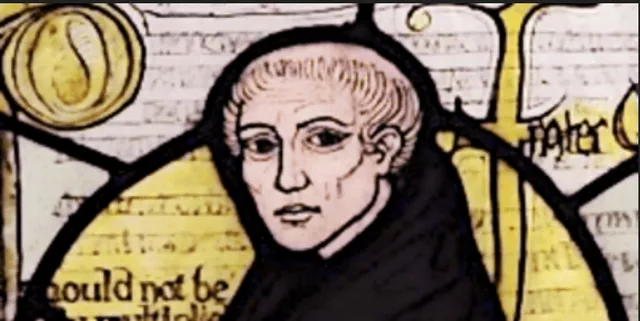
Founding fathers of scientific thinking - William of Ockham
Brief history of atheist thought in Europe, XII century c.e.
HistoricalBrief history of atheist thought in Europe, XII century c.e.
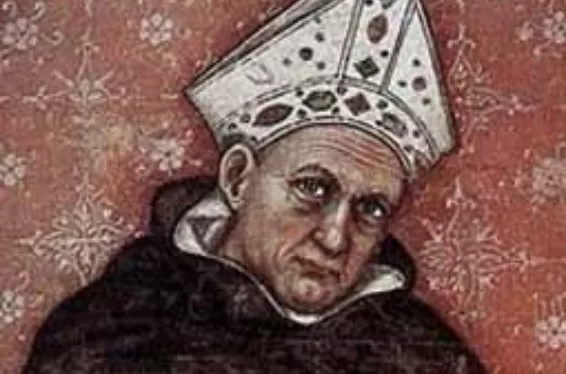
Thomas Bradwardine’s date of birth, given to be between 1290 and 1300 in Chichester, he attended Merton College until 1335. He chrome from an affluent family. He held Master in Arts and Bachelor in Theology degrees, as well as various posts in academia as well as cannon in the court of Bishop of Durham, that led to the position of a chancellor of St Paul's Cathedral in 1337 and chaplain to King Edward III. Bradwardine was elected Archbishop of Canterbury on 31 August 1348 and another time in 1349. He died in 1349 of the Black Death plague. (O'Connor, Robertson).
Bradwardine is mostly known because of his attempts to disprove atomism with geometry and velocity calculation through geometrical rations that involved force and resistance. Although his theory was incorrect, he made a significant contribution in the development of scientific thinking that proved beneficial for generations, reaching Johannes Kepler and his work in heliocentric astronomy.
He explored theology and logic as many of his predecessors in contemporaries before, in pursuit of understanding of Divine through science, that opened more avenues for development of logical analysis.
“Bradwardine was a noted mathematician as well as theologian and was known as 'the profound doctor'. He studied bodies in uniform motion and ratios of speed in the treatise De proportionibus velocitatum in motibus (1328). This work takes a rather strange line between supporting and criticising Aristotle's physics. Perhaps it is not really so strange because Aristotle views were so fundamental to learning at that time that perhaps all that one could expect of Bradwardine was the reinterpretation of Aristotle's views on bodies in motion and forces acting on them. It is likely that his intention was not to criticise Aristotle but rather to justify mathematically a reinterpretation of Aristotle's statements. Aristotle claimed that motion was only possible when the force acting on a body exceeded the resistance. Although he did not express it in these terms, it had also been deduced from Aristotle's Physics that the velocity of a body was proportional to the force acting on it divided by the resistance. Bradwardine used a mathematical argument to show that these two were inconsistent. He did this by assuming an initial force and resistance, then supposed that the resistance doubled, doubled again etc keeping the force constant. At some point, argues Bradwardine, the resistance will exceed the force so the body cannot move. But the velocity, given by the second rule, could not be zero. Bradwardine then claims that an arithmetic increase in velocity corresponds with a geometric increase in the original ratio of force to resistance. This cleverly removes the contradiction, but of course is incorrect. His view, however, was very influential and it was accepted as a law of mechanics for over a hundred years. For example Oresme followed Bradwardine's ideas of mechanics. Takahashi in [16] gives an interesting new interpretation of Bradwardine notion of ratios. Another interesting, but fallacious, argument was produced by Bradwardine when he tried to disprove atomism using geometry. However, he questioned the logic of his own arguments as he felt perhaps the existence of geometry already assumes that atomism is false. Bradwardine was the first mathematician to study "star polygons". They were later investigated more thoroughly by Kepler. Other works by Bradwardine include the following. On insolubles which discusses logical problems such as "I am telling a lie". On "it begins" and "It ceases" which argues that a temporal interval has a first instant but no last instant. The end of the interval is marked by the first instant of its non-existence. Speculative geometry contains elementary geometry which is not all based on Euclid. For example the "star polygons" referred to above appear here as does a discussion of the problem of the filling of space by touching polyhedra. This work, in four sections, is discussed in detail in [12]. Speculative arithmetic is based on a text by Boethius. There is argument between historians about which arithmetic text is the one due to Bradwardine. This is discussed, and a theory proposed, in [8]. On the continuum discusses the atomic theory. It follows Aristotle's views fairly closely. In it Bradwardine states:-
No continuum is made up of atoms, since every continuum is composed of an infinite number of continua of the same species.
This work is discussed in [14] where the author notes that this work by Bradwardine is a good early example of the application of mathematics to natural philosophy. On future contingents and In defence of God against the Pelagians and on the power of causes are Bradwardine's two major theological works. They attempt to argue against free will and in favour of Divine Will”."
J J O'Connor, E F Robertson, Thomas Bradwardine (article) - MacTutor CC 2000, WEB 2023
Aristotelian ideas dominated the thirteenth century. Scholars usually seek to braid every new dicipline with theology, Bradwardine was no exception.
Theological arguments dressed in terms of mathematics and geometry seemed to fill the problematic gaps in the arguments of faith, however, when applied to such vague and abstract ideas as contingency, complicated the matter even more.
As a result, providing logically acceptable, but baseless world view that bind many aspects of theology and science into the feedback loops.
Richard Kilvington - contemporary of Bradwardine, one of the first of “Oxford calculators” who advanced in the conceptualization of infinity, had influenced Bradwardine’s development of theory of motion and theology, he argued extensively with Ockham.
Thomas Bradwardine summarized Kilvington’s contingency arguments into nine questions and attempted to propose his own solution to the contingency problem. Highly abstract, this questions formulate unique perspectives of the relativity of the concept of the future that depend on the observer and future itself, that is uncertain and depend on the fact of observation.
"If the thirteenth century was the age of Aristotelian revival in the medieval universities, the early fourteenth century was a period of great diversification in the application of classical philosophical methods to problems o f contemporary interest. The basic tools of propositional logic and Euclidean mathematics which accompanied the Aristotelian revival allowed fourteenth-century thinkers to develop a variety of new approaches to long-standing philosophical dilemmas about complex issues such as time. The expansion of the curriculum in natural philosophy, especially at Oxford, encouraged students to conceive of old problems, even theological ones, in new ways. This movement has been called the "mathematization" of theology because fourteenth-century theologians not only discussed theological questions in physical and mathematical terms but in some cases adopted the axiomatic model of Euclidean geometry to present their theological arguments.'
Bradwardine's academic work provides an excellent illustration of this tendency towards "mathematical" theology. His mastery of Euclidean geometry and Aristotelian physics is a central feature of all of his major treatises.
...
Bradwardine could not escape from the influence of contemporary speculation at Oxford about contingency, which called into question the validity of a human-centered approach to time. Aristotle himself had addressed the problem of contingency, much in the same way as he had tried to solve the problem of beginning and ceasing, and so made an important contribution to an extremely complex debate. In the De incipit et desinit Bradwardine consciously avoided, as Aristotle had done, any consideration of broader philosophical or theological implications of contingency. By the fourteenth century, however, it was impossible to do full justice to the topic of contingency without taking into account the work of the Christian thinkers who had transformed contingency from a merely logical problem into a potent and controversial theological one. Their continuing efforts to establish a relationship between God's certain knowledge about the future and human uncertainty led to subsidiary discussions about a wide variety of difficult theological topics including predestination, free will and divine causation. Medieval theologians, in fact, made significant progress in bridging the gap between contingency as a logical problem and the temporal aspects of God's relationship with creation."
Dolnikowski, E. W., Thomas Bradwardine: a view of time and a vision of eternity in fourteenth-century thought - Leiden ; New York; Koln : Brill, 1995, p. 47, 73, 148
This egocentric perspective held back scientific progress by binding understanding of natural phenomena to the single point of view (such as flat earth and geocentric universe) still reveals itself in modern attempts to understand the behavior of light in double slit-experiment.
In the disputes between Bradwardine and Ockham we can see the issues of philosophical influence on science, and shaping of scientific thinking by philosophical theology. Although, both had somewhat different perspectives, the explicit bias of faith equally distorted their expectation, making them look for an answer that will fit acceptable dogmas.
"Bradwardine’s question is lucidly structured, at least as compared with Kilvington’s text. In the first half, Bradwardine examines and criticizes the following nine opinions:
- Nothing is future.
- Future things have no power for being or becoming. It is not through a thing’s own power that it comes to be in the first place, but rather by God’s power.
- Future contingents are not determined, and thus propositions concerning them have no determinate truth value, so are neither true nor false.
- Future things were not going to be from eternity, but only from a certain point in time.
- God does not in fact have any foreknowledge of future contingents.
- Since God is transcendent of time, past, present, and future are all present to God, and consequently what is future to us is not future to God. Thus, God’s foreknowledge is in fact God’s knowledge of what is present to Him.
- Nothing is contingent, but everything happens by necessity.
- Future contingent events are contingent, and thus God’s knowledge about them is also contingent.
- Future things which God explicitly foretells are necessary, but all other things are not.
The second part of the question—responsio propria ad quaestionem—begins with Bradwardine’s affirmative answer to his central question whether God has knowledge of all future contingents ad utrumlibet. In his further discussion, in which he offers arguments pro and contra, as well as answers to counterarguments, he proposes his own solution to the problem of future contingents, emphasizing the absolute and ordained power of God."
Jung, E., Michałowska M., Richard Kilvington Talks to Thomas Bradwardine about Future Contingents, Free Will, and Predestination - Brill NV, 2017, pp. 8-10
Bradwardine, however, contributed to the development of science by organizing Euclid and Aristotle geometry concepts taking into account “Arabic” commentary. New organizational structure provided an intuitive conclusion that mathematics and geometry could be a useful tool in pursuit of understanding the natural world.
"Other historians have observed that Bradwardine's approach to the problem of motion, though we might label it mathematical, had a firm and conscious philosophical basis. They see works such as the De proportionibus as evidence of a general development in early fourteenth century thought towards a new epistemology. In this context, Crombie remarks: "when Bradwardine rejected Avempace's 'laws of motion,' he made use of arguments similar to Ockham's, and it is difficult not to see a connection in the common shift of the problem from the 'why' to the 'how' which Ockham made as a logician and Bradwardine as a mathematical physicist. Crombie bases this statement on the observation that, in his Expositio super libros physicorum, Ockham not only repudiated Avempace's doctrine but did so by relying on the same concepts of space, time and magnitude which form the foundation of Bradwardine's theory." This is not to say, of course, that Ockham's approach to this topic was structurally identical to Bradwardine's. Quite the contrary: Ockham relied on logical distinctions and definitions which he expressed, for the most part, in a completely nonmathematical vocabulary, whereas, as we have seen, Bradwardine's logic was fundamentally a mathematical or geometrical exercise." The convergence of Ockham's and Bradwardine's philosophy cannot be seen readily in the De proportionibus but it becomes strikingly apparent in other works in which Bradwardine addresses broader philosophical problems such as infinity, continuity and contingency. Here it is sufficient to note that Bradwardine's mathematical studies can be seen to have a philosophical origin.
...
The differences between Bradwardine and Ockham on this issue are equally remarkable, however. Bradwardine was a staunch defender of Aristotelian physics: his mathematical transformation of Aristotle's physical theory was done in a spirit of respect and acceptance. Ockham, on the other hand, openly criticized the philosophical basis of Aristotle's physical system, while admitting that many of Aristotle's observations concerning motion, time and space were substantially correct. Nor were the analytical methods of Bradwardine and Ockham entirely compatible. Bradwardine chose a mathematical method along the lines of Grosseteste, while Ockham preferred the more traditionally logical approach of Averroes and Aquinas."
Dolnikowski, E. W., Thomas Bradwardine: a view of time and a vision of eternity in fourteenth-century thought - Leiden ; New York; Koln : Brill, 1995, p. 96-97, 101, 112
Bradwardine separate matter and motion, arguing that we can divide the former (infinitely) but motion itself is an indivisible concept, basing it on the connection to geometric proportionality.
Thus, he teied to use it as a universla instrument, that bocome a bridge between methphisics and natiral sciences.
"Bradwardine's position on the role of mathematics in philosophical inquiry, as it emerged in the De proportionibus and even more fully in the De continuo, developed out of his early studies in elementary geometry. Because geometrical analysis is the hallmark of Bradwardine's work, it is worthwhile to look briefly at one of his earliest treatises, the Geometria speculativa/" More a notebook than a treatise, the Geometria speculativa represents Bradwardine's attempt to organize all of the material on geometry which he had heard in the lectures required for the master of arts degree. His success in accomplishing this task is evident in the wide circulation of the text among students at Oxford and other European universities. The major sources for the Geometria speculativa were the mathematical writings of Euclid and Aristotle, although Bradwardine also referred at appropriate points to Boethius' Arithmetica and the Arabic commentaries on Aristotle. The contents of the Geometria speculativa covered all the major topics of elementary geometry, including the definitions of points, lines and angles; Euclidean theorems regarding these definitions; an analysis of polygons and circles; an examination of ratios; and a study of regular solids and spheres. Because Bradwardine intended his treatise to be a systematic review of what he had learned in the lectures rather than a work of original research, he generally chose not to advance his own opinions about controversial issues. His arrangement and treatment of standard topics nevertheless reflect his own style of mathematical thinking and reveal many of his philosophical assumptions.
Throughout the Geometria speculativa, for example, Bradwardine suggested that the discipline of geometry, and mathematics generally, could be useful in the investigation of natural phenomena. In making this claim, Bradwardine placed himself firmly on the side of the Aristotelians in the debate over of how best to use mathematics in the pursuit of natural philosophy. As we have already seen, some medieval mathematicians, following the Platonic tradition, argued that mathematics was a fundamentally conceptual activity; that is, they stressed the abstract qualities of mathematics and preferred to concentrate on abstract problems which were removed from any reference to physical reality.
...
Certainly the Geometria speculativa indicates Bradwardine's interest in applying the principles of geometry to problems in natural philosophy. It is here, for example, that Bradwardine first addressed the dilemma of infinity, a necessary concept in Euclidian geometry which directly contradicts Aristotle's assertion that the world is finite." By raising this issue at all, Bradwardine showed that he was already thinking about the convergence of metaphysics and physics in the study of mathematics."
Dolnikowski, E. W., Thomas Bradwardine: a view of time and a vision of eternity in fourteenth-century thought - Leiden ; New York; Koln : Brill, 1995, p. 83, 84
Bradwardine's true apposition to atomisms is in the dichotomy between occupied and non-occupied space, that translated into “Aristotle’s wheel” paradox, explained by Gilles de Roberval in the 16th century using the cycloid principle. In turn, the real number paradox arose that led to the famous work of Georg Cantor on different infinite sets.
"Bradwardine's analysis of the composition of continua forced him to think about a more complicated problem, one which Aristotle himself had only partially solved. Bradwardine's Euclidean models depended on the axiom that geometrical entities can be divided and that these divisions occur at specific points. Although he could conceive of such points as atoms, he did not consider them indivisible, as his opponents did. In Bradwardine's view, physical continua are even less subject to an atomistic analysis than geometrical ones, which led him to declare in proposition 100: "It is manifest that no natural substance is composed of finite atoms." There follows a geometric proof which demonstrates the equivalence of proportional velocities occurring in equal times. In fact, Bradwardine asserts, the opposite conclusion, that motions occurring in equal times are not proportional on account of their composition out of distinct indivisibles, is unreasonable and contrary to principles already proven in the De proportionibusi" As Murdoch observes, however, Bradwardine's distinction between the two conceptions of the physical composition of continua is not entirely convincing because it is based only on a negative argument.
...
Bradwardine then distinguished the beginnings of permanent things, which have first and last instants of being, from successive things, which have first and last instants of non-being. In other words, permanent things are intrinsically bounded while successive things are extrinsically bounded. To say otherwise, one would have to assume that a thing must have both a last instant of non-being and a first instant of being and, consequently, that continua are composed of immediate indivisibles." According to Murdoch, Bradwardine's views about beginning and ceasing had an important function in his overall strategy against the atomists. Bradwardine's success in this enterprise rested on his ability to perceive the inconsistencies of the atomist position and to tailor Aristotelian physical theory to suit the particulars of the debate."
Dolnikowski, E. W., Thomas Bradwardine: a view of time and a vision of eternity in fourteenth-century thought - Leiden ; New York; Koln : Brill, 1995, p. 129, 147
The disconnect between infinite and finite persists to this day, making the gap of theoretical application of mathematics and its application ever wider. Eternal choices of eternal entity that should shape the future - not an easy concept to grasp, let alone explain. However, Bradwardine’s attempt to finalize his position by a highly speculative assumption that appeal to religion, corresponds with the spirit of his time. Like his predecessors and contemporaries, he unknowingly highlights the limitation of theology that contributed to future scientific revolution.
«Bradwardine begins his refutation of atomism with an examination of several types of continua, both mathematical and physical, and in the process he explicitly delineates his view of time. At the outset o f the De continuo Bradwardine introduces his conception of time as a continuum in a series of definitions pertaining to continuous substances. After defining the continuum itself as a quality whose parts are mutually connected (ad invicem copulantur), he proceeds to distinguish between permanent continua, whose parts exist simultaneously, and successive continua, whose parts, in the words of Aristotle, succeed according to before and after (succedunt secundum prius et posterius). In definitions four, five and six Bradwardine gives solids, planes and lines as examples of permanent continua. Definitions nine and eleven establish time and motion as successive continua. Definition ten defines an instant as an atom of time. In these definitions, Bradwardine emphasizes the connection between motion and time by defining motion as a successive continuum measured by time (continuum successivum tempore mensuratum). Time, on the other hand, is measured not by motion but by its own successiveness: tempus est continuum successivum suecess ionem mensurans.»
Dolnikowski, E. W., Thomas Bradwardine: a view of time and a vision of eternity in fourteenth-century thought - Leiden ; New York; Koln : Brill, 1995, p. 125
A major innovative contribution by Bradwardine consists of understanding the limitation of available thinking tools. Systematic approach to knowledge required standardization of terms that will allow application of mathematics to other areas of knowledge.
"At the heart of Bradwardine's argument about future contingents, says Leff, is his notion that God's will defines future events by making choices which stand for all eternity. Although God potentially could have made different choices from the ones which he actually did make, his ultimate decisions are eternally true: creation is the process of these decisions coming to fulfillment in time. God cannot subsequently make a different decision without changing himself; and to change, God would have to make himself a creature subject to time." Therefore, to say that God cannot change something that he has willed is not to doubt God's absolute freedom but to give God's free choices the respect due to them as eternal truths. According to Leff, Bradwardine locates his opponents' main error «in confusing this eternity in God with temporal measurements, thereby trying to judge the infinite by finite standards. . . . As a result, rather than acknowledge the problem of the future, he denies it.»
Dolnikowski, E. W., Thomas Bradwardine: a view of time and a vision of eternity in fourteenth-century thought - Leiden ; New York; Koln : Brill, 1995, p. 191
In the pursuit of scientific discovery, Bradwardine realized that the mathematical tools of his time are not sufficient. In order to understand such limitation, one have to do extractive and qualitative research, practice, as well as to possess self critical faculties.
His original work on velocity went beyond direct Aristotelian proportionality, resulting in the proposition of the new law of motion.
"Bradwardine's originality lay not so much in his support for the idea that mathematics should be at the disposal of natural philosophy for, as we have seen, he was not the first to make this claim. His reputation as an innovator rests instead on his application of proportional theory to a mechanical problem which had previously defied mathematical analysis. Bradwardine did not, of course, come close to articulating the principles of advanced mathematics which later allowed Newton to explain the properties of motion more elegantly and, in a modem sense, more accurately; but his recognition that elementary geometry and algebra are inadequate for describing such concepts as force, velocity and resistance had a profound effect on future scientific investigation. Bradwardine's insight that the medieval natural philosopher required a better mathematical language, coupled with his conviction that natural philosophy could not be well understood without mathematics, explains why historians associate Bradwardine with Galileo and other formulators of modem scientific thought.
...
Bradwardine's theory of the "proportionality of proportions," as it later came to be called, was based on his rejection of the traditional formulation of Aristotle's law of motion which claimed that velocity could be doubled either by doubling the force or halving the resistance. In the first place, although this particular ratio of force to resistance might be true in some cases, it could not be applied to all motion: most motions do not conform to a strict two-to-one ratio. Second, Bradwardine believed that a simplistic interpretation of Aristotle's law would suggest that any force can move any object, when in fact motion only takes place when force exceeds resistance. What was required instead was a new interpretation of the laws of motion which took into account the exponential character of force : to double a velocity, Bradwardine concluded, one does not double the force but square it. Or, as Weisheipl explains,
Bradwardine proposed a new law, maintaining that a double velocity must follow from the entire power-to-resistance ratio duplata, i.e., not multiplied by two, but squared, for twice a proportio tripla is one which contains the ratio 3:1 twice. But only the square of the ratio, i.e., only 9:1, contains twice the proportio tripla, for the ratio 9:1 is composed of 9/3,3/1. Thus only the ratio squared can give twice the velocity. Similarly, triple velocity follows from the ratio triplata, i.e., raised to the third power. Conversely, half the velocity would follow from the medietas of the ratio, that is, the square root of the ratio; one third of the velocity follows from the cube root, and so forth; thus the mover can never be less than the resistance. Bradwardine's exponential function was theoretically valid fo rall cases, and it eliminated the possibility of zero-velocity. Today the latter situation is taken care of by a logarithmic function."
Dolnikowski, E. W., Thomas Bradwardine: a view of time and a vision of eternity in fourteenth-century thought - Leiden ; New York; Koln : Brill, 1995, p. 87, 92
Brief history of atheist thought in Europe, XII century c.e.
Historical
Brief history of atheist thought in Europe, XII century c.e.
Historical
Brief history of atheist thought in Europe, XII century c.e.
Historical