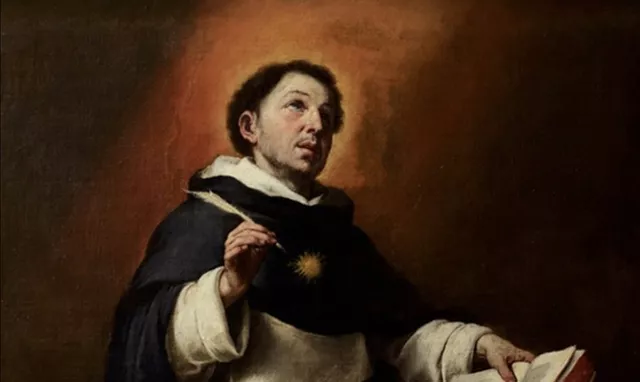
Founding fathers of scientific thinking - Thomas Aquinas
Brief history of atheist thought in Europe, XII century c.e.
HistoricalBrief history of atheist thought in Europe, XII century c.e.
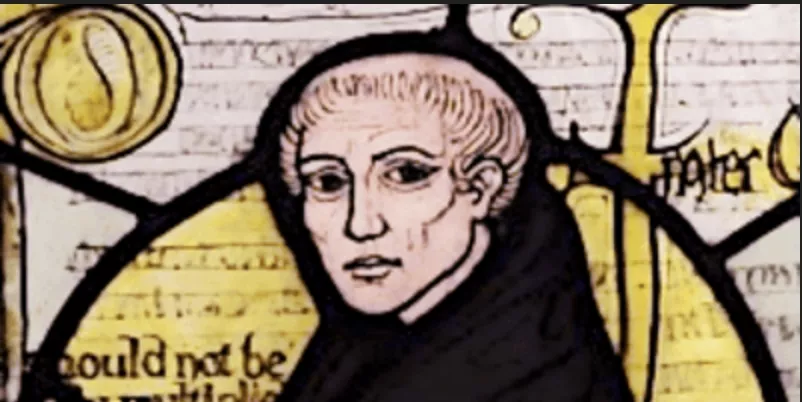
William of Ockham (also incorrectly spelled as “Occam”) born in England, his family “donated” him to the Franciscan friar order where he got his initial education. He studied at Oxford, London, Avignon and Munich, where he died in 1347. Ockham was greatly influenced by Aristotle and Peter John Olivi (fierce critic of Aristotle, who was condemned as a heretic).
Ockham known to us in conjunction with the principle of “Ockham’s razor”, however he was not the original source of this idea. He borrowed it from his contemporary John Duns Scotus, with whom they shared interest and critique of Aristotelian interpretations of Aquinas.
"William of Ockham was born around 1288 at the rural village of Ockham in Surrey, a day’s ride southwest of London. Nothing is known of his family or social background and thus whether his native language was French or Middle English. Having joined or, more likely, been given to the Franciscan order as a young boy before the age of fourteen, Latin quickly became his language of conversation and writing. When he later went to Avignon, visited Italy, and lived the last twenty years of his life in Germany, it was probably through Latin that he communicated with those among whom he lived.
No Franciscan convent existed in the region of Ockham’s birth, although the Dominicans maintained a convent at the nearby town of Guildford. Ockham’s earliest education before entering the Franciscan order was more likely obtained through the local parish priest or perhaps at the house of Austin Canons at Newark.1 His grammatical and philosophical training, however, was received from the Franciscans in the opening years of the fourteenth century, probably at Greyfriars2 in London, which may also have been his “home” convent.
The London convent was the principal teaching center for the London custody, one of the seven administrative units into which the English province of the order was divided. Alongside Oxford, London had the largest Franciscan convent in England, which was situated on the northwest edge of the old city at Newgate with around 100 friars usually in residence.3 Its size was needed to facilitate its mission to the largest city in England and to take advantage of proximity to the royal court and episcopal residences that lay along the Thames between the city and Westminster. London Greyfriars was also the principal residence of the Franciscan provincial minister for England when he was not abroad on business of the order.
...
What those influences were depends very much on knowing the years in which Ockham was probably resident in London. We know that he was in London in February 1306, when he was ordained subdeacon at Southwark by Robert Winchelsey, archbishop of Canterbury.4 Because there is no indication that he received a dispensation for being younger than the minimum canonical age for that minor order, nor any reason to believe his order would have delayed his first ordination much beyond the canonical minimum, it has been assumed he was eighteen at the time, from which the approximate date of his birth is conjectured.5 According to that reasoning, he would have been twenty-nine when he began reading the Sentences in 1317–1318, approximately the normal age for that academic exercise.
...
By 1310 Ockham had advanced to the study of theology. Because there was no strict sequence of courses that marked the stages of the internal Franciscan educational program before the baccalaure- ate, young friars probably availed themselves of whatever lectures were being given so long as there were places in the classroom and the stu- dent had sufficient training to understand the material and analysis. Ockham would have begun his studies in theology either at the custodial school in London or at the provincial studium generale with which the London custody was affiliated, namely Oxford.
...
The Oxford to which Ockham was sent for the baccalaureate pro- vided an exciting intellectual environment for the young Franciscan. Henry of Harclay, a secular theologian who had studied at Paris before returning to Oxford, was elected chancellor of the university in 1312. In the previous decade at Paris, Harclay had been deeply influenced by Scotus and had participated in the editing of Scotus’s work and in the discussions that created the first generation of Scotists at Paris.8 With his return to Oxford, however, Harclay moved in a different direction and, alongside Richard Campsall, began to criticize assumptions of Scotus in metaphysics and natural philosophy. Harclay formulated positions on the question of universals and the Aristotelian categories that antic- ipated elements in Ockham’s thought as expressed a few years later in the latter’s Oxford lectures on the Sentences.
Courtenay, W., Ockham and ockhamism : studies in the dissemination and impact of his thought - Brill NV 2008, pp 92-93, 94, 95
Known for “Ockham’s razor”, that perceived as a universal principle, however for Ockham it was a tool for logical reasoning, among many. He accepted this tool in dialectical application to Aristotelian principles, and did not rejected criticism of his conteporaries.
Ockham’s logic is based on the necessity of premises that have to be drawn from experience that can be elaborated upon to form a range of other probabilities, keeping reasonable doubt in mind. From a strictly linguistic sense, this construct does not seem to be elaborate, however in the terms of logic it is a significant transformation of logical analysis that we find in Aquinas and Scotus.
When neither side of a disputed question can be strictly demonstrated and reasons can be given for both, the razor tips the scale in favor of the simpler solution. Ockham quotes with approval the saying of Duns Scotus: "Every plurality is reduced to unity or to the smallest possible number."
The importance of the razor in Ockhamism is attested by the fact that Ockham's anonymous follower who wrote the Tractatus de principiis theologiae between 1328 and 1350 could draw eightyone of his conclusions from it.
Ockham does not call the razor a maxim - a term he seldom uses but one that was commonly employed by Boethius and earliermedieval logicians for a dialectical or topical proposition. Indeed the razor does not appear in the traditional lists of these maxims. Rather, Ockham calls the razor a principle (principium)\ but it seems to fit the Aristotelian-Boethian description of a dialectical maxim, accepted by everyone or by the majority, especially by the wise. Another apt term for the razor is Boethius' "common conception of the mind" (communis animi conceptio), denoting a statement accepted by everyone or at least by the learned as soon as it is heard. This was the term given to the razor by Peter of Candia, who died as Pope Alexander V in 1410.
...
In defense of the reality of the "small entities" eliminated by Ockham, Walter Chatton, a contemporary critic of Ockham, devised his own counter-principle or anti-razor: "My rule," he declared, is that "if three things are not enough to verify an affirmative proposition about things, a fourth must be added, and so on." He thought Ockham was too parsimonious in estimating what entities should be posited in order to verify propositions such as, "A is the efficient cause of B." In Ockham's view there is no need of a third reality, namely a real relation of causality. As we have seen, he considers the two absolute realities of cause and effect to be sufficient. Chatton replied that a third, relative reality, is needed. For consider the proposition, "A produces B." Because God is omnipotent, he can produce A and B by himself; then the same two absolute realities exist but God and the two things by themselves cannot verify the proposition, for now it is not A but God who produces B.In order to verify the proposition, a third reality - a real relation of causality - is needed.
In his dispute with Chatton, Ockham does not reject the anti-razor out of hand, for he agrees with Chatton that all the items needed to verify a proposition must be affirmed. But he calls the anti-razor false "unless it is better understood," and again, "false as it is generally understood." The misunderstanding he refers to is the use of the razor in conjunction with the divine omnipotence. As we have seen, Chatton argues that if God miraculously made A and B exist, they could not verify the proposition "A produces B" and therefore a third relative reality of causality is required. But Ockham retorts that if God works a miracle, the addition of a hundred things would not be enough to verify the proposition "A produces B." Why not? Because now the proposition is false: not A but God produces B. In the ordinary course of nature, and excluding miracles, two things are sufficient to verify the proposition/3 This shows that Ockham intended the razor to be used in philosophy along with the dictates of reason and experience and not with God's extraordinary workings.
...
If the razor has the status of a dialectical principle in Ockham's philosophy and theology and in this capacity plays a significant role in them, it is important to know how much weight he gives to it and to his positions based explicitly or implicitly on it. Is the razor only a commonplace or expert opinion whose opposite might equally well be true, or is it a true and even a (conditionally) necessary axiom? Are the conclusions based on it plausible and not necessarily convincing, or do they call for our firm and unquestioning assent?
There are no sure answers to these questions in the works of Ockham. We can be certain that he regarded the razor as a principle, not in demonstrative but in dialectical reasoning, and as such it plays a significant though subordinate role in shaping his views on reality and the mind. It is also probable that the razor should be interpreted in the light of the notion of dialectical reasoning set forth in the two mature logical works of Ockham: the commentary on Aristotle's De sophisticis elenchis and the Summa logicae."
Maurer, A., The Philosophy of William of Ockham - Pontifical Institute of Mediaeval Studies, CA. 1999, p. 124-125, 127, 129
However, this logic inevitably clashed with religious dogmas, although already challenged with many opinions and interpretations that flourished on the abundance of contradictions found in the scriptures. Ockham's statement on separation between deed and spoken word lead to superiority of natural laws above all, therefore hinting at the idea of multiplicity of ways natural law can unfold. In that sense, Christian factions and sects could manifest Christianity in their own way, however, no matter what they do, if they keep alight with its intent they will not contradict each other and the intent of the scripture.
"Taken strictly, dialectic "proceeds to prove a true conclusion from true and probable [premises]: not from those that are self-evident or adequately known from experience, but from those that are known from authority or in some other plausible way."
Continuing hisdescription oidialecticautens,Ockham explains that it takes for granted first principles, such as the principles of the excluded middle and noncontradiction; it neither proves them nor questions them as though they were doubtful. Ockham's final point is that the dialectician sometimes makes use of necessary and evident propositions - even those that are self-evident - but his syllogism always contains a nonevident premise, implying that if the syllogism did not, it would not be dialectical but demonstrative.
This description of dialectic conforms quite well to the traditional notion of dialectical reasoning. It is clearly distinguished from demonstration and induction, for its premises are not evident or adequately drawn from experience.
...
In the Summa, Ockham begins his treatment of the dialectical or topical syllogism in the traditional way, by contrasting it with the demonstrative syllogism. The latter is said to give us knowledge of a conclusion from evidently known premises, whereas the former begins with probable opinions (probabilia). As for the meaning of "probable" in this context, Ockham cites Aristotle's Topics: "And those [opinions] are probable that seem [to be true] to all or to the majority or to the wisest." This corresponds to the broad sense of "probable" in the commentary on the De sophistiris elenchis.
...
Whether an argument is dialectical in the strict or wide sense, Ockham makes it clear that it always begins with probable premises (probabilia). He also explains that in this context probabiledoes not always mean probable in the sense of doubtful. He has told us that a dialectical argument in the strict sense is ex probabilibus, understood as propositions that are true and necessary, and assumed to be such by everyone or by the majority, especially by the wise. Probabile here should not be taken in our sense of "likely" or "probable" but in its etymological meaning of what is provable, or what is worthy of approval, or readily believable."
Maurer, A., The Philosophy of William of Ockham - Pontifical Institute of Mediaeval Studies, CA. 1999, p. 114, 115, 118
This indirectly allowed any disciple to question the central authority of the Church, if inquiry was “scientific”.
In order for that inquiry to be considered “scientific”, Ockham proposes to revert from multiplicity of linguistic interpretations into a fixed understanding of the terms that lead to unity of understanding. This seems to hint at the possibility of development of a completely synthetic language (similar to Latin or Greek), essentially making it closer to the concept of John 1:1 “In the beginning was the Word”. Obviously, an impossible proposition.
"Student Because of the great plausibility that the arguments brought forward for both opinions seem to have, I desire to probe them further and to hear how they are answered in accordance with the different opinions. So first relate how the first opinion tries to answer the arguments brought forward in the last chapter.
Master The first -- which is based on the premise that all Christians cannot do anything contrary to an ordinance of Christ -- is answered by means of what was laid down in chapter 20, namely that necessity and utility make permissible what would otherwise be impermissible as being contrary to an ordinance of Christ. And therefore, although all Christians are Christ's disciples and slaves and are not above him, nevertheless, from necessity or utility they can do something contrary to an ordinance of his that is, against his words and deeds according to what at first they seem to express, though not against his intention; for he means that in his words, where he ordains or does something the opposite of which is not at all opposed to the natural law and he does not make explicit that necessity and utility should by no means be excepted, urgent necessity and evident utility are excepted.
An attempt is made to prove this in another way than before. As we read in Matthew 5[:39] Christ commanded his apostles not to resist evil, but if someone struck them on one cheek they should offer the other also; and yet it was permissible for the apostle Paul when he was struck to say to the chief priest, "God will strike you, you whitened wall,"92 as Augustine testifies in his sermon on the centurion's son, quoted in 23, q. 1, c. Paratus. Therefore, just as, according to Augustine in the same place, Christ's commandments concerning patience were "rather to the preparation of the heart than to the work done in the open, so that patience with benevolence should be held in the secrecy of the mind, but outwardly we should do what seems beneficial to those to whom we should wish well," so, concerning Christ's ordinance about appointing one highest pontiff, we should do what is more beneficial to his Church, for whose utility he ordained that one highest pontiff should be appointed: namely, so that when it is beneficial for the Church that there should be several, then let there be several to rule the Church aristocratically."
McGrade, A., Kilcullen, J., William of Ockham A Letter to the Friars Minor and Other Writings - Cambridge University Press 1995, pp 181-182
Yet, Ockham's syllogistic reasoning that derived from the idea of linguistic universality is a demonstrative syllogism, bringing us back to Aristotelian logic. The contingency of truth, distinguishing between meaning and knowledge (Maurer 1999) allowed Ockham to formulate an understanding of science that has to be based on evident knowledge and demonstration. Building in the work of Aquinas, he is going to the next level of understanding what science should be: a unity of multiplicity of subjects and mental states.
"The setting up of a model in the way described avoids the introduction of concepts foreign to Ockham's thought. However it is apparent that the model could be easily mapped into a more 'traditional' model. We would take classes as primitive (although they are defined from an Ockhamist point of view), replace the truth of sentences of the form 'a is F' by the belonging of an object a to a set, and replace the truth of sentences of the form 'hoc est F for given objects by the satisfaction of formulas with free variables by the same objects. It is important that such a mapping be possible, for the purpose of comparing an Ockhamist model with known models.
A unique interpretation and an ideal language.
The model we are setting up features a unique interpretation of the terms of the language. It departs in that respect from usual models, that include an infinity of interpretations. In the latter case, the terms of the language can be correspondingly assigned any number of different 'denotations' according to the interpretation chosen; and truth for sentences of the language is relative to an interpretation. In our Ockhamist model, the assignment of 'denotations' to a term is fixed, since the interpretation is unique. Consequently truth is not relativized to an interpretation.
A model built in such a way is closer to natural languages, where the 'meaning of words is relatively fixed. We may consider our predicate letters as being abbreviations for Latin terms, and we would not expect that 'homo' for instance could be stipulated to denote what in English is referred to by 'raven' under one interpretation, and by 'horse' under another, and so on. The fact that the meanings of terms is fixed is reflected in our model by the unicity of our interpretation. That unique interpretation can be readily described, although certainly not in its particulars; it includes the entire universe; namely all the individuals that at any time exist, have existed or will exist are named, and everything that at any time has, is or will be truly predicated of any object also has a term for it.
Now what are the disadvantages, if any, of having a model which gives fixed assignments to terms of the language, in other words a model that includes only one interpretation? The following: what may seem to be an exhorbitantly high requirement must be placed on the language, precisely those we have mentioned, namely that every object and every predicate be named."
Karger, E.C., A study in William Ockham's Modal Logic - University of California, Berkeley, Ph.D. Philosophy, 1976, p. 70-71
When it comes to abstract concepts, philosophers of the 13th century had very little useful tools to make any coherent mental maps. They elaborated endlessly. To minimize superfluous thinking, Ockham attempted to get to a simple, yet unifying alternative. Contradicting Scotus, he criticizes him for extravagant extrapolations, although he agreed with his basics of Aristotelian interpretations.
In his “being as being” concept, we on one hand find solid ground that would allow arriving to unbiased observation of nature, but on the other - it opens the door for even more future interpretations and projections that biulding bridge to nowhere. In any case, this can be considered as a step in development of true scientific inquiry.
"Ockham uses the term scientia in a broad sense to cover not only demonstrated scientific conclusions but also other types of knowledge and even belief. In general it is "the certain knowledge of any truth." This includes truths known only by faith. We may not have seen Rome, yet we know on the witness of others that it is a large city. We also know who our father and mother are even though this is not evident to us. As long as we adhere to a statement without any doubt and it is true, we can be said to know it. In a more restricted sense of the term, scientia is the evident knowledge of some contingent fact known by experience; for example, that a particular wall is white. More limited still, scientia is the evident knowledge of necessary truths, whether they are principles or conclusions drawn from them. In the strictest sense scientia is the evident knowledge of a necessary truth that can be caused by the evident knowledge of necessary premises used in syllogistic discourse. In short, it is the necessary conclusion of a demonstration.
...
The question of the immediate object of scientific knowledge was warmly debated in Ockham's day. His Franciscan confrere Walter Chatton opted for the realistic position that science is directly founded on the reality signified by the terms of its propositions, namely subjects and predicates. Its immediate object is not (as Ockham claimed) the propositions demonstated by science. Ockham's follower, Adam of Wodeham, tried to find a via media between these two opinions. In his view, the object of science is neither the conclusions of scientific demonstrations nor external reality itself, but the adequate signification or meaning of the conclusions thus demonstrated. Adam's suggestion was not popular in the Middle Ages, but it assumes some importance in the modern philosophy of meaning.
...
As a consequence Ockham devised his own conception of the subject and object of a science, its unity, and its distinction from other sciences. He defines the object of a science as the whole proposition known in the science and its subject as the subject term of the proposition. Since a science is made up of many propositions, each of which may have its own subject, a science cannot be said to have just one primary subject which gives unity to the science. A total science is composed of many parts with many subjects. For example, metaphysics draws conclusions about being but also about God, so that both being and God function as subjects of metaphysics.
Each science, then, is a collection of many propositions and mental dispositions (habitus) to know or to demonstrate them. A science is not a single habitus of the mind, as Aquinas and Henry of Ghent believed. Its unity is that of an collection, «in the same sense that a city, a nation or an army, which includes men and horses and other necessities, or a kingdom, a university, or the world, is said to be one.'»
Maurer, A., The Philosophy of William of Ockham - Pontifical Institute of Mediaeval Studies, CA. 1999, p. 135, 139, 142
The interpretation of science by Ockham can be summarized from two basic points of view: it is a state of mind, and it consists of many elements, and it’s immaterial. The state of mind depends on “self-evident” propositions that are deducted from common understanding of “natural laws”, thus should bring thinkinr to «univocal conceptualization».
"We shall have occasion later to examine Ockham's criticism of Henry's doctrine of knowing God through analogous concepts. For the moment we shall concentrate on Ockham's own views on how we know things. First, we can know something directly and just in itself, as when we see a fire. Second, we can know something, not in itself but in a concept proper to it and verifiable of it. Now, when we know something in itself, we know at once that it is (quia esty and what it is (quid est), for we cannot know it unless we know its essence or some part of its essence in itself. But when something is not known in itself, we know that it is before knowing what it is. For example, in a lunar eclipse we first know that something has come between the sun and moon and only later what this is.
Now, as far as God is concerned, we cannot know his essence in itself, or anything intrinsic to him, or anything that is really God himself, in such a way that nothing else accompanies our knowledge of him. A cognition of the divine reality just in itself would be an intuition of that reality, and, as we have seen, this surpasses our natural powers.
... Ockham does not reject Scotus' method of arriving at univocal concepts of God, but he fears that Scotus understood it incorrectly. It is absolutely false, he says, to think that a formal nature (ratio) found in creatures - whether or not anything is abstracted from it - can be ascribed to God as though it exists in him. Ockham insists that nothing really existing in a creature, no matter how abstracted from it, can be attributed to God. He points out that Scotus himself claimed that nothing real is univocal to God and creatures; they have only a concept in common, and this exists neither in God nor in creatures.
Ockham alerts us here to the basic opposition between himself and Duns Scotus and his followers on the nature of univocal concepts. The Scotists would form univocal concepts by abstracting the formal natures (rationes} of things, leaving aside their differences. Being, for example, would be abstracted from all its modes, ultimately even from the primary modes of finiteness and infinity, and considered only as being: ens inquantum ens. The result is the univocal concept of being."
Maurer, A., The Philosophy of William of Ockham - Pontifical Institute of Mediaeval Studies, CA. 1999, p. 271, 286-287
Ockham has work to resolve contradictions in universals, making statements that was controversial at his time. He viewed the individual as a composite of human nature and malicity, in which we need to account for the connection between human nature and individuation, however his opinion was that we are unable to give such an account. Ockham Denied connection of individuation and trinity, denied the concept of trinity on the grounds that we can’t distinguish them from philosophical grounds. He stresses the unreasonability of current understanding of Christianity. When faced with a dilemma of contradiction between reason and Christian dogma, Ockham decided not to shy away from pointing out the contradictions.
To understand nature, Ockham perceived that we need only two concepts: substance and quality. He developed an idea that minimization of concept will lead to their unification, providing that they initially do not contradict natural laws. He believed that conclusions have to be supported by demonstration.
"Philosophers search for the causes of things; and so it is incumbent on them to look for the causes of natural science. Aristotle recognized matter and form as causes intrinsic to things, and efficient and final causes as extrinsic to them. Which of these are causes of science? The answer depends on the nature of science. For Ockham, the first and most basic meaning of science is a stable mental ability or disposition (habitus) to reason to a certain conclusion. In itself each scientific habit is a single quality produced in the mind by numerous mental acts in accord with the scientific method. Some of these individual scientific habits naturally come together to make up a total science, as in the case of natural science. Now, in the first meaning of science (as a single mental habit) its causes are not matter and form, for these causes only apply to a composite reality and not to something that is perse incomposite. The mental quality that is a part of science is an accidental form of the human mind, and so it does not have a form, and for the same reason it does not have matter. In sum, as a simple reality (res simplex) science does not have matter and form as its causes. In the second meaning of science (as a collection or aggregate of mental habits) its intrinsic causes are not matter and form, for it is not composed of them but of many mental habits in the category of quality.
Strictly speaking, then, science has only efficient and final causes. Ockham reports several opinions of what its efficient cause might be. Some say the efficient cause of science is the mind; others that it is the object of science; others that it is the incomplex knowledge of terms, or a combination of these opinions, or something else. He does not discuss the matter further in his Summula philosophiae naturalis, but its excellent editor helps us to identify the authors of these opinions and Ockham's own position. Peter Olivi held that the mind is the efficient cause of science; Godfrey of Fontaines that the efficient cause is not the mind but the object of science. Ockham himself seems to have opted for the incomplex terms of science. In his Ordinatio he says that evident knowledge is the knowledge of a complex truth or proposition that is adequately caused immediately or mediately by the incomplex knowledge of its terms. It seems to be Ockham's mind that a self-evident proposition is known immediately by the knowledge of its terms; a scientific proposition is evident mediately, through the terms of the premises of which it is the conclusion. As for the final cause of natural philosophy, it is what is intended by the one learning and acquiring it."
Maurer, A., The Philosophy of William of Ockham - Pontifical Institute of Mediaeval Studies, CA. 1999, p. 380-381
Brief history of atheist thought in Europe, XII century c.e.
Historical
Brief history of atheist thought in Europe, XII century c.e.
Historical
Brief history of atheist thought in Europe, XII century c.e.
Historical