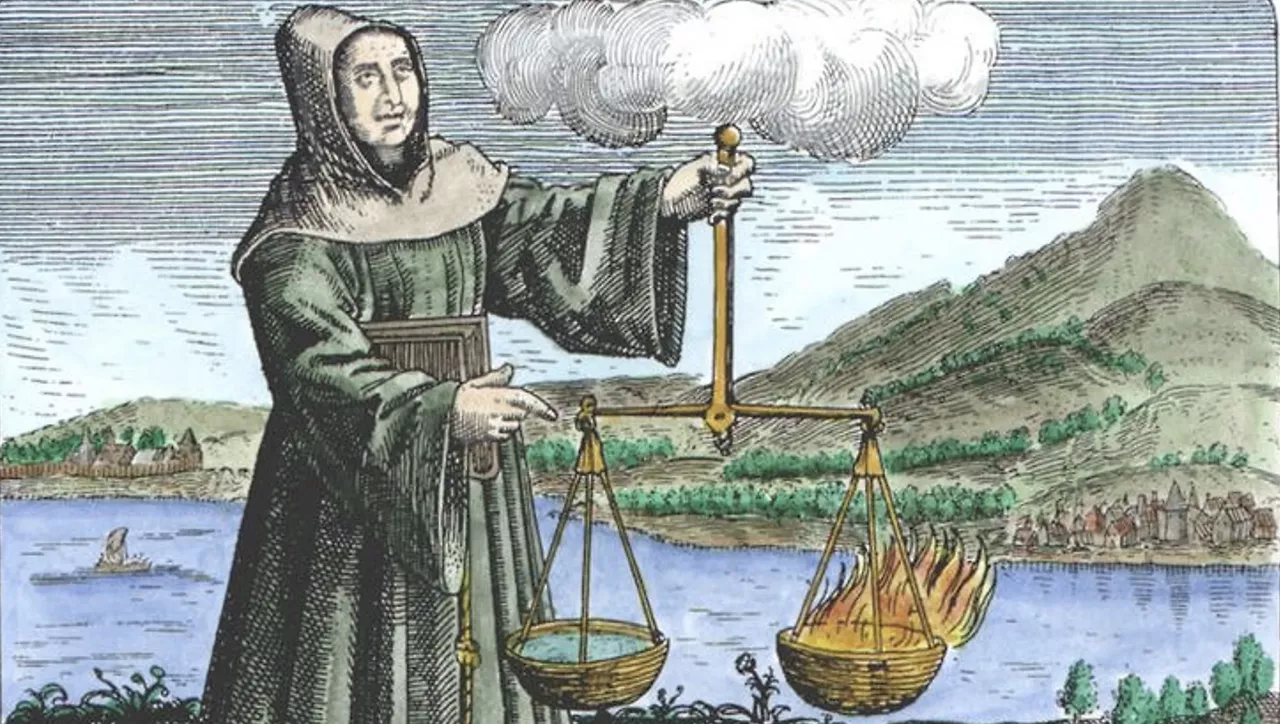
Founding fathers of scientific thinking - Roger Bacon
Brief history of atheist thought in Europe, XII century c.e.
Roger Bacon’s Bio
Roger Bacon’s life details are not known, there are disputes on dates of birth and death and the place of his grave is lost forever, his porters do not exist. Bacon’s persona is surrounded with legends, he is attributed with mystical powers and groundbreaking inventions. However, all the scholars agree that he was indeed a Franciscan friar and produced works that greatly influenced European scientific and theological thinking.
The most recent reconstruction of Bacon’s life, summarized in the following passage:
“Some time after 1248, he set aside the common scholastic ways of teaching in order to devote time to languages and experimental concerns. Thus, we can see the period from c. 1240–48 as the time during which he lectured at Paris on Aristotle, on Grammar/Logic, and especially on the mathematical subjects of the Quadrivium. And so, depending on the chosen year of birth, the chronology would be as follows: (1) Bacon was born c. 1214, educated at Oxford c. 1228–36, Master of Arts at Paris c. 1237–47/8, Private Scholar 1248–56/7, active again at Oxford c. 1248–51, back in Paris 1251, Franciscan Friar at Paris c. 1256–57 to 1279, returning to Oxford c. 1280, died c. 1292. Or: (2) Bacon was born c. 1220, educated at Oxford c. 1234–42; Master of Arts at Paris c. 1242–47/8, active again at Oxford c. 1248–51, back in Paris 1251, Franciscan Friar at Paris 1256/7 to 1279, returning to Oxford c. 1280, died c. 1292. Further precision on the chronology must await the critical edition of all the works of Roger Bacon and careful scientific study of these works in relation to other thirteenth century scholars.”
Hackett, Jeremiah, "Roger Bacon" - The Stanford Encyclopedia of Philosophy (Summer 2020 Edition), Edward N. Zalta (ed.), WEB 2023
Roger Bacon’s works provide fascinating insights into ways of unification of Aristotelian philosophy, Middle Ages theology and the beginnings of experimental science.
Being heavily invested into Aristotelian views and indoctrinated as Franciscan, Bacon thinking influenced by Robert Grosseteste’s theory of multiplication of species. He produces many manuscripts that build up into his Great Work - Opus majus, divided into 7 parts: 1) Errors of thinking, 2) Philosophy and theology, 3) Knowledge of language and grammar, 4) Mathematics, 5) Optics and Light, 6) Experimental Science and 7) Ethics.
He then produces Opus minus, and the Opus tertium to consolidate his works, but also added new ideas. The scope of his thinking and particularity of topics provided great insights for generations of scientific thinkers of Europe.
Reform of Studies
There are two main qualities that provided the foundation for Bacon’s thought process: familiarity with historical sources and understanding of contemporary philosophical models. Bacon doesn’t create new knowledge per se. He borrows heavily (sometime verbatim and without reference (Hackett, 1997)) from Latin translations of Greek and Arabic scholars, that appear to make profound influence on him. Bacon compiles many sources, analyzes and reimagine ideas through the lens of his Franciscan training.
"The later works of Bacon, especially those written after 1266, are not for the most part systematic and disinterested treatises. They are, rather, a mixed collection of small tracts on a diversity of topics. These tracts are linked together in the service of a polemic about the education of university students in Paris in the mid-thirteenth century.
The reform of education and society is a theme which was close to the interests of Bacon in his later years, that is, from about 1266 to 1292. His criticism of the scientia of Albertus Magnus, his strictures against Alexander of Hales and Richard of Cornwall, and his general condemnation of the young friars of his times, were all part of his belief that studies in the arts, medicine and theology had degenerated in the course of his life-time.
Bacon saw himself as a spokesman for an older form of study, namely, the kind of secular and sacred study which had been fostered by Robert Grosseteste, Bishop of Lincoln (ca. 1168-1253), who had been the first lecturer to the Franciscans at Oxford from 1229-1235. Bacon also praised scholars who had some association with Oxford and Lincoln such as Adam Marsh, Robert Marsh, William Lupus, William of Shyrewode, and Thomas of Wales. His praise of these scholars is repeated many times in contrast to his condemnation of the vulgus studentium.
...
The structure of Bacon’s works about 1266-1272 reflects both this central vision of a reformed life and the particular changes that he thought were necessary in studies. From the introductory letter to the works for the pope, it is evident that the organization of the Opus maius, Opus minus, and the Opus tertium, follows a distinct pattern. Moreover, this pattern is repeated in the Compendium studii philosophiae and in the Compendium studii theologiae. The pattern consists of (i) a critique of the errors in studies, (ii) a study of the relation of philosophy to theology, (iii) a review of the deficiencies in language study, (iv) a study of the role of mathematics, especially geometry, and astrology in learning, (v) a review of the place of perspectiva in studies, (vi) the relation of experimental science to theology, (vii) a review of moral philosophy as the goal of the other areas of study. There is much repetition of material in the above mentioned works. Bacon continued to repeat and also to make additions in all of his later writings.
...
Bacon’s program of studies in the Opus minus and in his other works postdating 1266 is one in which secular learning is seen to be essentially of service towards the interpretation of Sacred Scripture. For him, philosophy is not seen as a totally self-sufficient pursuit. Rather, it finds its goal in the service that it renders in being an ancilla for the study of theology. The account of the sciences and philosophy in Bacon’s later works is largely a polemic for the uses of the liberal arts in the reading of Sacred Scripture."
Hackett, J. et al, Roger Bacon and the sciences : commemorative essays - Brill, NY 1997 p. 49, 51, 53
Latin translations
When philosophy in Europe started to emerge from the dark ages that follow the fall of the Roman Empire, there were very little writing sources available. Main source of research was Latin translation of the Arabic scholars, that preserved Greek and Roman philosophy in their teachings. Accuracy of that translations was in question. Franciscans had to collect, reconstruct and make sense from them, so most likely misinterpretation was introduced as well.
For Bacon was acceptable to infer and deduce, formulating the concepts that he will not credit to their source. Nevertheless, Bacon's work exceed in research and compilation.
"Throughout his statements on the rise of aristotelian studies at Paris, and incidentally on the fate of translations which had made it happen, Bacon seemed to envisage no other time perspective than the period of forty years (1230-70) of free flight, preceded by a long one (1210 to 1230) of abject igorance of natural science forcibly imposed by the condemnation of the libri naturaks in 1210/1215. The inaccuracies in Bacon’s dating of events and the notable gaps in his information were sufficiently documented by Thorndike and Wingate so as to render superfluous belaboring of the charges. Yet while these critics seem timid or embarassed, there may exist more fundamental factors behind the shortcomings in Bacon’s assertions. For if we realize, as we must, that the 1210 condemnations included in their broad, indiscriminate sweep nearly all writings on natural science made available to European scholars in translation from the Arabic since the early twelfth century, the fuzziness inBacon’s information may then be seen as one patent example of the blight these condemnations, cast upon the memory of scholars a generation later concerning the history and role of these translations. Bacon’s surprising ignorance of the facts is but a mirror of such damage.
...
1. Bacon’s apparent neglect of the massive movement of translations of scientific works from the Arabic since the beginning of the twelfth century cannot but be astonishing, especially on the part of one who made such uninhibited use of them. He nearly incorporated the work of Gerard of Cremona into the contemporary scene, he decidedly confused Hermann of Carinthia (whose translation of Abu Ma'shar he freely used; all manuscripts of this version mention Hermann as translator) with Hermann the German with whom Bacon held direct conversations etc.26 No inkling about the importance of translations done in the twelfth century, v.g. by Plato of Tivoli, John of Seville, Adelard of Bath, Robert of Chester and still others, although Bacon does acknowledge the importance of Adelard’s atti tude to new science. He markedly contrasts the new rational science of Adelard with the blindness of mere appeals to authority.
2. Bacon’s strictures against the competence of his contemporaries Hermann the German and William of Moerbeke as translators are also well known but no less misplaced. Without any serious examination of their translations, Bacon declares ex cathedra that these translators ignored both the sciences they were handling in the translations and the languages from which they were translating. Such a serious charge should have been thoroughly documented to escape being considered absolutely unconscionable. The only grounds on which Bacon bases his sweeping criticism are purely subjective: “sicut ego expertus sum omnino”.28 To reinforce his judgment Bacon does not hesitate to proclaim that he had read more than any one else in these matters: “et audivi diligenter plures, et legi plus quam aliis, ut omnes qui nutriti sunt in studio non ignorant” (ibid.). Bacon’s own pretense at knowing these languages is never properly substantiated and there seems to lurk more personal animosity than truth in the wild accusations against contemporary translators.
...
While maintaining that the originals, either greek or Arabic, are much better than what the Latin translators offered, Bacon never produced credible example of what he would deem a good translation. Conversely, the stress he lays on the superiority of the spurious Aristotle is nowhere supported by a valid demonstration. Compounding his arrant ignorance—or was it deliberate oversight?—, Bacon laments the fact that the Latins are far from possessing all of Aristotelian science. He illustrates his point by citing a work of Aristotle of allegedly major importance entitled De impressionibus calestibus which the Latins did not yet possess, urging the pontiff (Clement IV) to provide for its translation."
Hackett, J. et al, Roger Bacon and the sciences : commemorative essays - Brill, NY 1997 p. 29, 38-39, 45
Man of his time
Bacon makes prolongation of human life and betterment of health his main objective - that topic was most relevant to his contemporaries socially and scientifically. He uses “lamp and oil” metaphor (human body as a lamp that use oil as the source of energy, imagining fire as a metaphor for human life) a popular meme of his time that describes inner energy relations of the human body and how human nature determined by sin (Allen, 2023).
"...Bacon was writing at a time when the possibility of the prolongatio vitae was not only widespread, but was a socially and scientifically acceptable pursuit. Many individuals, including those trained at some of the best medical faculties in the European universities, believed that humans could and should try to regain some of the time lost by previous generations. The idea that life had significantly shortened since the age of the patriarchs was nearly universally accepted, and it made sense that something should be done to address this. Bacon may have been unique in his approach to the prolongatio vitae, using speculative and practical alchemy to confer incorruptibility, and equating this incorruptibility to the resurrection body, but he certainly was not alone in believing it possible.
...
In his 2017 book, Franciscans and the Elixir of Life, Zachary Matus used the term “subjunctive” to describe the Franciscan tradition of alchemy, especially that regarding elixirs of health. This subjunctivity viewed the world as it should be, rather than how it actually is."
Meagan S. Allen, Roger Bacon and the Incorruptible Human, 1220–1292 - Palgrave Macmillan, UK 2023, p. 73-74
Roger Bacon’s pursuit of light and optics, as well as ethical views also rooted in Franciscan tradition and their interpretations of The Scriptures. Light plays a significant role in Christianity as a representation of divine power. He describes experiments in great details and to his credit, he admits to fall short to be able to explain narrowing of light beyond aperture in De speculis comburentibus (Lindberg 1997).
Franciscan tradition
Bacon insists that to understand medicine, one have to understand natural philosophy, language, mathematics, alchemy and astronomy, provided they all have common source - Divine wisdom, that could and should be accessible to every man, by design, as well as his pursuit of this wisdom is ethical in nature (Allen, 2023).
"Light was equivalent to God and The Good, for light is what emanated from God, and was the cause of all things. It was no less than the form of corporeity, which first gave form to formless matter. When St. Francis received the stigmata in 1224, it was the light from the seraph that imprinted the wounds onto his body. St. Francis achieved the pinnacle of ecstatic union with God—deification—through the action of light. For this reason, light was held sacred to the Franciscans, who were above all interested in physical oneness with the Divine.
Thus, not only should Bacon not be viewed as unique in his use of light metaphors in describing the soul’s reception of grace, but it is apparent that the Franciscan practice of natural philosophy was incredibly influential on Bacon’s understanding of the resurrection. Indeed, even Bacon’s Opus maius can be described as being Franciscan in character. Franciscans created texts that would allow the contemplator to understand the symbolism of things in the world, which would then explain their allegorical meaning in the Bible. The familiarity with natural things gleaned from such texts could help the contemplator ascend the ladder to deification."
Meagan S. Allen, Roger Bacon and the Incorruptible Human, 1220–1292 - Palgrave Macmillan, UK 2023, p. 200
Bacon focuses on the attempt to employ thinking from outside of Christendom to explain and advance understanding of “God’s creation”, arguing that Cristian tradition, and moreover proselytization, will benefit from external sources of (possible) knowledge. He argues that even Aristotle, although pagan by his upbringing, received knowledge of science from God and therefore “can be saved” (Hackett, 1997). This is a significant statement and a very dangerous position to have at his times.
Opus maius: The Polemic
Roger Bacon promotes the idea of purification of “Truth, Art and Nature” (as well as substances in alchemy), from trickery and magic (Hackett 1997), and seeks to branch specific areas of knowledge and combine them into new separate disciplines with their own sub-classes.
«Bacon had a very good historical sense of things. He knew that in the Ancient world, the intellectual elite had used the combined resources of astrologia and magic in the affairs of state. He would have known this from Augustine, De cwitate dei and other works. He acknowledges that “The art of Magic besides was increasing in strength throughout the whole world, and seizing on people under every form of superstition and religious fraud; and although it was hated by philosophers and fought by them all, yet the early sacred writers finding the world occupied with it as well as with philosophy, reckoned both as the same art, since both in many ways were hindering the fruit of faith.” Because of this, Christianity rejected the sciences and philosophy due to the abusers of those subjects, and thus, it did not receive a full complement of the works of science and philosophy until quite recently in Bacon’s times. Bacon therefore sets out to prove that “the holy patriarchs and prophets at the beginning of the world received all the sciences from God ... to the end that, when the faith of Christ was introduced and the fraudulence of the art of Magic was purged away, the power of philosophy might be advantageously applied to divine things.»
Hackett, J. et al, Roger Bacon and the sciences : commemorative essays - Brill, NY 1997 p. 176-177
Division of learning
He proceeds even further, by dividing science into practical and speculative type, seeking to separate abstract concepts from practical experiences. However, he struggled to keep theoretical from practical only by means of logic, trying to create a method that will keep them apart.
"Bacon, then, begins with a brief account of the division of learning in his own works. This is best seen in the following schema: I. First in the order of exposition is grammar in regard to Latin and foreign languages, together with logic. II. Mathematics, which is divided into common and special. III. Natural philosophy, which is divided into common (the exposition of Aristotle) and special (the outline of the seven sciences). IV. metaphysics. V. moral philosophy. Bacon sees moral philosophy as the end of all the other sciences. It supplies the practical good and the goal towards which the other “speculative” sciences are to be directed.
...
Bacon’s main point seems to be that the omission of the seven special sciences from the schools led to a deficiency in the teaching of the liberal arts, and as a consequence to a deficiency in the study of philosophy and theology. The following is a schema of Bacon’s sciences, including the seven special sciences which he wished to emphasize in the Christian education of his time.
Constructed schema from a combination of Communia naturalium and Opus maius, part four. The asterisk indicates a new science. Hackett, J."
Hackett, J. et al, Roger Bacon and the sciences : commemorative essays - Brill, NY 1997 pp. 57, 63
Speculative versus practical sciences
Bacon conducted many experiments to test his ideas, especially in the field of optics and light (Allen 2023). Although he stated in his writings that he spent large sums of money on scientific instruments and books, he never had enough resources to test his hypothesis in every field of interest. Most of his in-depth writings in alchemy, astronomy and “predictions of the future technologies” seems to be elaborations on known facts.
"The increasing influence of scholasticism on the medical field meant that theory was incorporated into practice, and many medical texts of the thirteenth century were also divided into practical and speculative sections. Johannitius’ Isagoge, for instance, began with the claim that medicine had two parts: theory and practice. Theory was further subdivided into three additional sections: the study of the naturals, non-naturals, and contra-naturals. All were necessary to understand sickness and health. Likewise, the Methodus medendi explained Galen’s division between theory and practice, and included examples of each. Galen, borrowing from Aristotle, saw sickness as belonging to a specific entity, and should be understood as such. Theory was universal, practice was individual. For Galen, the universal was far more important: he cared more about the disease than the individual patient’s experience.
In terms of diagnostics, this meant that when doubt arose, the physician should use reason, not individual evidence. If the diagnosis came down to either what was visible to the senses or what was clear to reason, then reason should prevail. Thus for Galen, theoretical medicine, and its allowance for the “clinical schematism” popular in the late Hellenistic period, was superior to practica. He was also afraid that if he placed too much weight on individual patients when designing his nosographic scheme, medicine would be reduced to a mere accumulation of cases, and the doctor would be stripped of pathology or therapy not tied to the individual, something dangerously akin to the empiricist school of medicine.
Borrowing from Galen, the Pantegni defined theoretical medicine as abstract concepts, or the knowledge of things grasped by the intellect, and includes subjects such as the elements, humors, virtues, complexions, six non-naturals, and contra-naturals. Practical medicine, on the other hand, applied the knowledge gained in theory to manual operation, and thus taught how to use diet, medication, and surgery to preserve health and treat disease. Students of medieval medical theory would base their study around the rules contained in Greco-Arabic works.
Not only did Bacon divide alchemy into practical and speculative types, he also divided almost every field into practical and speculative components.
...
However, this does not necessarily mean that Bacon’s pharmacology was speculative. Creating better standards of drugs was, for all intents and purposes, a practical goal. At best, it can be argued that Bacon, like many thirteenth-century medical writers, was clear about the division between speculative and practical sciences when writing, but could not really apply these distinctions in the real world."
Meagan S. Allen, Roger Bacon and the Incorruptible Human, 1220–1292 - Palgrave Macmillan, UK 2023, pp. 150-151, 157
Thought experiments
One of his major practical contributions we can find in the field of cartography. Bacon believed that in order to understand the stories in The Bible, one have to understand described locations, their geographical positions and influence of the starts. Good maps would also provide missionaries with advantages in the work of conversion of people into Christianity.
"Twentieth-century scholars tended to criticize Bacon for his lack of experiment, especially in light of his proposed experimental science. Even the idea of “experience” from a trusted authority apparently went against the statement in the Opus maius that authority was not a good way to acquire knowledge, because only experience could remove all doubt. How does his approach to experiment in medicine hold up to these claims? If we look at Bacon from a modern perspective, then certainly, his experimental practice was lacking. In De erroribus medicorum, when discussing all the different things that can effectively purge humors and prolong life, Bacon said that the only one that he had tried was rhubarb, but he had been very pleased by the results. Specifically, he said, “And I myself use it [rhubarb] against phlegm according to the words of Aristotle, but I do not use the gross substance since I know that it is better to extract its virtue.” However, this discussion of rhubarb did not appear in the context of performing experiment, but in a debate about misinformation regarding simple medicines! Most Latin doctors agreed that rhubarb purged choler, while the Greeks (namely Aristotle) claimed that it worked against phlegm. Bacon was stating that he successfully used rhubarb against phlegm not to provide an example of experimentation, but to support Aristotle’s claim against the Latin doctors. His reasoning that rhubarb worked against phlegm was thus a mix of self-experimentation and Aristotelian authority.
In fact, very little can be said about Bacon’s personal experimental practice, at least in terms of the prolongatio vitae. While his mathematical works show that he was testing ideas, such as burning mirrors, and parts of the Opera contain sections on alchemy that have enough practical information to suggest that he was at least dabbling in practice, there are no comparable passages in his discussions of the prolongatio vitae."
Meagan S. Allen, Roger Bacon and the Incorruptible Human, 1220–1292 - Palgrave Macmillan, UK 2023, p. 69-70
What is significant about Bacon thinking, is not the scope of his views and multiplicities of theories, most of which were fundamentally wrong. His application of systemic inductive thinking to known facts and concepts of experimental science as well as unifying view, that all the disciplines and branches have to commit to unifying interdependency, makes Roger Bacon standout among his contemporaries. However, his initial approach to the importance of intellectual understanding of the scriptures, seems to stem specifically from the writings of nine-century Persian scholar Abu Nasr Al-Farabi.
"The emergence of revelation in the imagination of the prophet: Farabi believes that in order to receive divine revelations and revelatory teachings, the imagination of the prophet must have reached the highest degree of human perfection in order to be able to understand those teachings. After receiving the divine teachings by connecting the prophet to the active intellect, those teachings appear in the imagination of the prophet, and it is here that the imaginative power of the prophet, with the power and capability he has acquired through the attainment of perfection, turns the general intellects into parts.
From Farabi's point of view, the imagination of the prophet is completely obedient and submissive to the power of reason, and whatever the power of reason in general receives, must be manifested in part in the power of imagination. Farabi considers the imaginative power of the prophet as active as the rational power connected to the active intellect, and for this reason, in his opinion, no mistake is made in converting this general knowledge into partial knowledge in the imaginative power of the prophet (Farabi,1938,18- 19).
Eskandian A., Nezhadian M., A Philosophical Approach to Explaining Divine Revelation in Farabi's Thought (Article) - Turkish Journal of Computer and Mathematics Education Vol.12 No 13 (2021) p.4902, WEB 2023
Theoretical pursuit
It is important to mention that Bacon's view of scientific development was not as a pursuit of knowledge in itself. For him, it was foremost an instrument in the fight against evil forces and the Antichrist that seeks to destroy humanity with forces of nature. At the time, prevailing opinions of theologians supported the idea of a coming apocalypse, which should happen in the near future. Bacon thought that it can be prevented, if people will master forces of nature by science, that comes from God. Some scholars speculate that Bacon conducted numerous experiments in alchemy, necromancy and magic, in order to utilize their powers on behalf of The Church.
"Rather, they examined them from within they own paradigms instead of trying to understand them from within the 13th century friar’s own. Once Bacon’s apocalypticism and scientific
theories were viewed together, however, Abate argued that the two seemingly distinct facets merged to produce a veritable “physics of the Apocalypse”: Central to Bacon’s apocalyptic vision was his belief that a secret science was divinely revealed to humanity during the antediluvian period.
Due to human abuses it was retracted by God but would reappear in the last days. The apocalyptic dramatis personae, all humans, would utilize it to harness hidden natural forces and transform prophetic potentialities into physical realities. Bacon transformed all the figures of the Apocalypse into good or evil natural philosophers… the ancient science which all apocalyptic figures would use was a blending of astrology and alchemy that permitted its practitioners to “force nature to obey their will,” and this science was a re-articulation of astral magic purged of demonic incantations.” While this purging of astral magic into something which might be more palatable to orthodox Christian theologians may have begun in Bacon’s lifetime, the process took centuries to unfold, and the issue continued to be debated well into the Renaissance, usually with Christian Kabbalah or pseudo-Dionysian mysticism as its foil.
Our friar’s solution to the problem of a rising Antichrist was to ‘fight fire with fire,’ or as already mentioned, to use his opponent’s weapons against them. The imminent Antichrist would rage as Scripture foretold, but his rage would manifest through the channels of natural causation. These were channels which had been discovered through a diligent study of Aristotelian science, and as such, the ‘fire of the antichrist’ so to speak was replicable via natural experimentation."
The Man Who Hated the Antichrist: Roger Bacon by Dan Attrell (video transcript) The Modern Hermeticist, YouTube.com WEB 2023
The mystery of Roger Bacon
It would be fair to say that Roger Bacon was mostly a theoretician than a practitioner. He attempted to approach many disciplines and systematize them into an interdependent structure that will serve one purpose. He started, however, from the notion of infallibility of scripture, taking stories of Adam and Eve and longevity of prophets as undisputed facts. Furthermore, he assumes the existence of universal medicine and absolutely pure substances that can be created by the means of alchemy.
Building his logic on many authors of the past, especially Arabic translations of Aristotle, Bacon proceeds to create his own distinctions of physics and metaphysics. He performed many experiments, most of which were thought experiments, that nevertheless provided a structure of logical insight that was more important in the development of scientific thought than actual experimental results.
It is very hard to approach Roger Bacon in the format of one article. Although, there’s no doubt that this multifaceted personality left a significant imprint on the scientific way of thinking of European tradition, many questions remain.
Bacon constantly reused his materials in different writings, making it hard for researchers today to accurately authenticate his authorship (Allen 2023). The scope of his ideas seems to demonstrate an outlier among his contemporaries, his personal life events are obscured and biography have significant gaps.
We might speculate: could the existence of the concepts of pseudo-Aristotle and pseudo-Ptolemy may also suggest a pseudo-Bacon, created by Franciscan order?