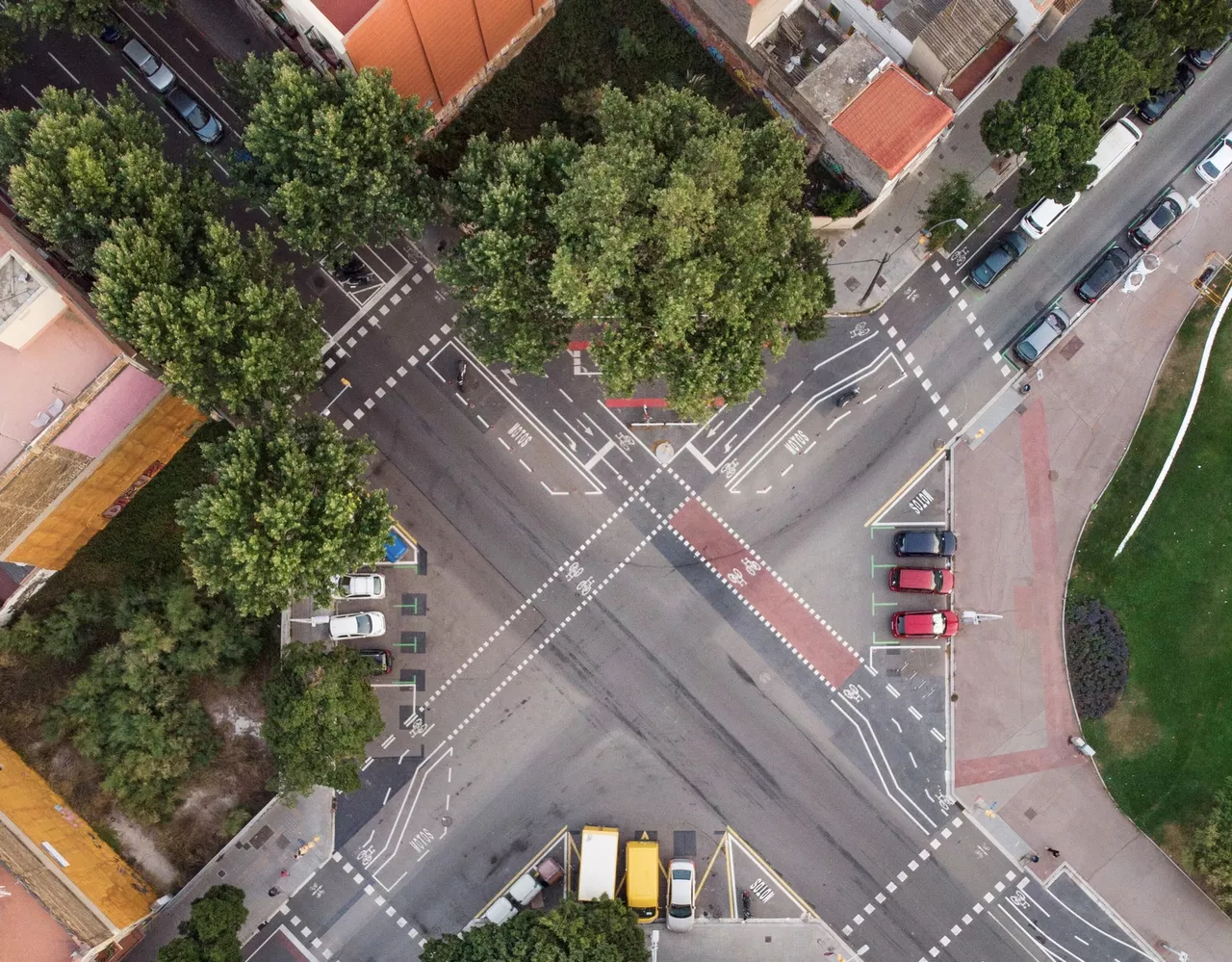
How to design the buffer depends on budget and climate. In heavy snow areas, raised buffer zones can provide plowing challenges, but cities that are committed to high-quality facilities will build next to each crosswalk a small island that occupies the parking and buffer areas together. This is the technique that New York City has used on many of its facilities. In its ideal version, shown at right, this island is matched by another one that projects into the intersection in order to neck it down, tightening the curb radius so that vehicles don’t speed around the corner. When two cycle tracks intersect, these details, which separate cyclists from both cars and pedestrians, are especially useful.
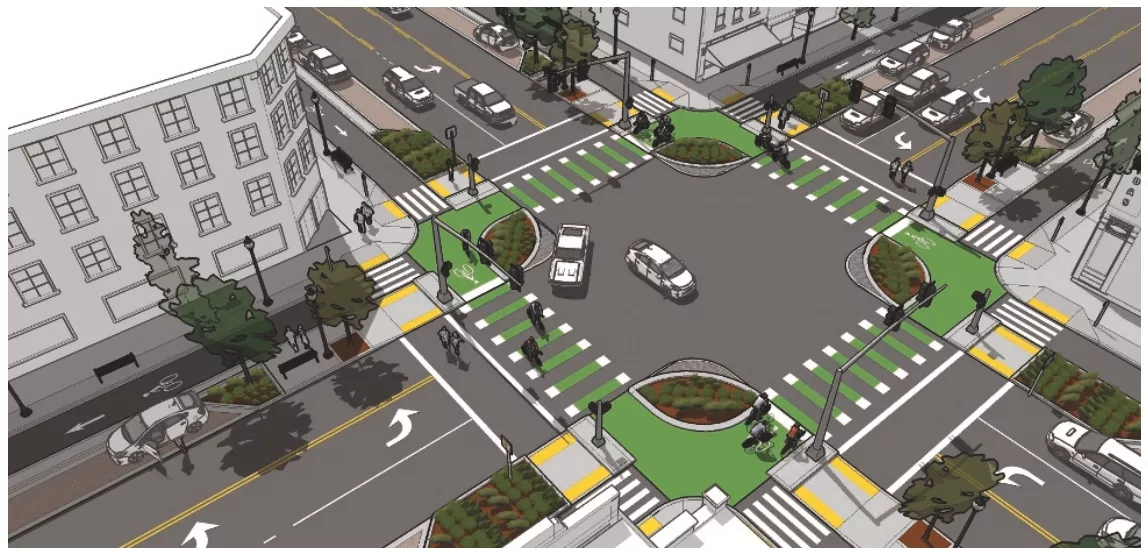
Away from intersections, it is a nice touch to raise the buffer zone with curbs—even to provide it with ground-cover—but this should be considered a luxury. It is better to stripe 100 blocks of cycle tracks than to build 10 for the same cost.
When inserting bike lanes into existing streets, bulb-outs (curb extensions) in the parking lane can appear to be an impediment to creating proper cycle tracks. The solution is to angle the bike lane away from the curb as it approaches the corner, essentially angling it through what was previously the parking spot closest to the intersection. This move should result in the loss of only one parking space on each intersection approach.
Cycle tracks and protected lanes should not be confused with what are called “buffered lanes.” These provide some distance, but no substantial physical barrier, between the bike lane and the traffic that flanks it. The buffer is typically striped at an angle to indicate that it is a no-go zone for cars and bikes. In streets with parallel parking and room for a buffer, it is of course safer to provide protected lanes than mere buffered lanes, but the fire department often insists on the latter in order to maintain twenty feet of clear space in the roadway. As discussed in Rule 51, this requirement deserves questioning.
Most design guides recommend, in the absence of curbs, filling cycle track buffer zones with flexible vertical posts as well as angled stripes. While effective, the problem with these is that they are ugly, and result in a visually busy and discordant streetscape. While beauty should not trump safety, it seems reasonable to assume that, over time, as Americans become more accustomed to using this infrastructure, the posts can be removed and the stripes replaced with a simple contrasting pavement color.
Speck, J. , Walkable City Rules: 101 Steps to Making Better Places - Island Press 2018, WEB 2024 pp. 140-141

The rise and decline of the American ghetto (case study)
The "ghetto phenomenon" and its roots.
Knowledge Base